About Coenonympha tullia Müller, 1764
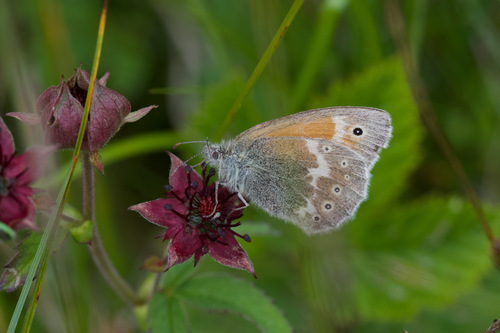
This entry for Coenonympha tullia Müller, 1764 originally appears in Seitz, where it is referred to as C. tiphon Rott. (synonyms: davus F., tullia Hbn.). The upperside of the nominal form is sandy yellow, similar to Coenonympha symphita but rather duller. Males have no markings, while females have ocelli that shine through from the underside. On the underside of the hindwing, joined whitish smears form a more or less incomplete median band; beyond this band, males have some ocelli, and females often have a complete row. The nominal form occurs in Central Europe, especially in the Alps, Central and Southern Germany, and the Danube countries. The subspecies and forms are described as follows: philoxenus Esp. (= rothliebi Stgr.) is a rather large northern form, dulled grey on the upperside and strongly marked with ocelli on the underside; it is found on the continental shores of the North Sea and Great Britain, and is also reported to have occurred at Lemberg. Ab. laidion Bkh. is a slight deviation from the nominal type, with slightly paler ochre-yellow upperside; it is found rarely as an exception among nymotypical populations anywhere the species occurs. isis Tnbg. (= demophile Fr.) has a grey rather than brown underside, with fewer and smaller ocelli; its upperside is also greyish and completely without markings. This form ranges from Scandinavia and North Russia as far as Central Asia. viluiensis Mén. (= grisescens Christ.), from the Vilui river in Siberia and the Werchojansk mountains north of Jakutsk, is bright grey rather than yellow on both sides. The whitish median band of the underside of the hindwing shines through to the upperside and is shaded grey toward the base; the base of the hindwing underside has a greenish wash. caeca Stgr., from the Namangan Mountains, is a small form with no trace of ocelli, making it superficially similar to Coenonympha pamphilus. mixturata Alp. is the most eastern form of the Old World, from Kamschatka. It has no ocelli on either side, similar to the American form ochracea, but is pale grey on the upperside rather than the pale yellowish brown of ochracea; on the underside the hindwing is grey, and the forewing is ochre yellow with a grey margin. Across the Behring Sea in Alaska, the species is represented by the closely allied form kodiak Edw. The most western Old World form is scotica Stgr., from Ireland and Scotland; it has a dull grey ground colour and dark edges on the upperside, and no ocelli on the underside. subcaecata Ruhl, from the higher Altai, is an intermediate form closely allied to ochracea from Colorado; it is darker and larger than caeca, but paler than isis, and single specimens show faint traces of ocelli. rhodopensis Elw., now accepted as the separate species Coenonympha rhodopensis Elwes, 1900, is a form from the Danubian countries closely allied to isis. It is yellowish brown on the upperside, rarely darker in males. Only the pupil of the apical ocellus, and sometimes that of one hindwing ocellus, shines through to the upperside. On the underside of the hindwing, this form mostly has a complete row of ocelli, while the otherwise closely related form occupata Reb. has no ocelli at all; occupata occurs in Bosnia and Herzegovina. The larva is pale green, covered in tiny dot-like warts, with a globular green head, yellow mouthparts, a dark dorsal line with pale edges, whitish subdorsal lines, and a pale yellow lateral stripe; its anal claspers and anal fork are rosy red. Larvae develop from September until May on rushes, reeds, and grasses including Carex, Rhynchospora, and Festuca. The pupa is pale green, with a whitish abdomen. Adult butterflies are on the wing in June and July, occurring singly, and are uncommon on most of their flight sites. Sometimes entirely fresh specimens turn up in locations where no individuals had been recorded for decades of active collecting, and the species may disappear again from these sites for long periods. Flight sites are usually peat bogs and periodically flooded meadows; according to Ruhl, these habitats especially support the species where Eriophorum grows.