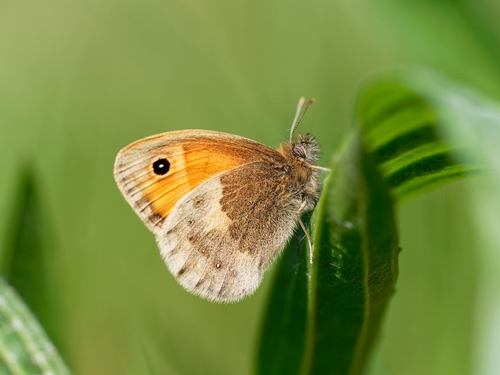
About Coenonympha pamphilus (Linnaeus, 1758)
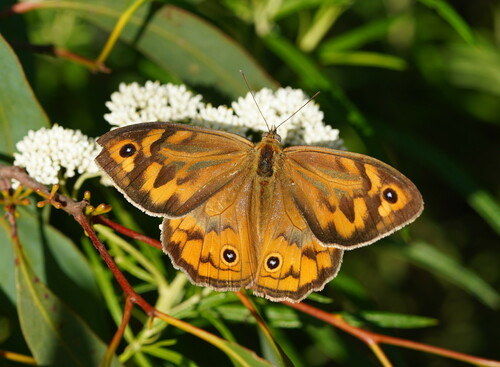
Coenonympha pamphilus (Linnaeus, 1758) is a small butterfly species. Individuals of the nominal species have upper wings the color of reddish yellow sand. The underside of the forewing is reddish yellow, bordered with grey, and bears a small pupilled apical ocellus; the hindwing is diluted with grey, with a shortened, curved whitish median band shaded with brown. Ocelli are generally completely absent, or only marked by faint, indistinct vestiges of dots or rings. The northern form, pamphilus L. (= nephele Hbn., menaleas Poda, gardetta Loche) (48 g), has mouse grey ground-colour on the underside of the hindwing. This is the only form found in the North, and it ranges across North and Central Europe to Anterior Asia, Turkestan, Ferghana and Persia. In the aberration bipupillata Cosm., the apical ocellus is greatly enlarged and doubly pupilled. The form marginata Stgr. (48 g) has a very broad dark distal margin on all wings, but its underside matches that of lyllus. A broadening of the blackish distal margin also occurs in the summer brood in many localities. lyllus Esp. is the summer form from Southern Europe, North Africa and the southern part of Anterior Asia. In this form, wings are broader, the apex of the forewing is more rounded, the margin of the hindwing is often undulating, and the underside of the hindwing is not mouse-grey, instead being sandy yellow with a fine curved median line. The form Thyrsides Stgr. (48 g) occurs in Sicily, Dalmatia and the southern portion of Anterior Asia; typical specimens have also been found in the valleys of the Atlas. On both sides of the hindwing, this form bears a submarginal row of ocelli, which are sometimes pupilled. The larva is bright green with a thin double white dorsal stripe and a yellow lateral stripe. Its head is pale green, and larvae develop on grasses throughout the summer. The pupa is stout, green, with darker markings. Adults are the most common Satyrids across all of Europe, and are on the wing from the end of April until October. They can be found almost anywhere, including meadows, fallow fields, cornfields and bare hill summits. They almost only fly when disturbed, and quickly settle again; they favor roads and bare patches of ground, and sometimes tilt their always closed wings to one side. Their flight is slow, low, and jumping. They even fly into towns, wandering through gardens and yards, and can sometimes be seen hopping along busy paved streets before settling briefly on pavement. The small heath is distributed across the entire Western Palearctic. In Europe, it has been recorded in at least 40 different countries since 2002; it is common in the United Kingdom, found largely in England and Wales. Populations also occur in southwest Siberia, other regions of Asia, and North Africa. As a grassland species, the small heath prefers open habitats with shorter grass than related species. It can be found across a wide range of environments including meadows, heaths, subalpine mountain zones, and alongside railways. It has been recorded in calcareous grasslands across nineteen European countries. For mating and oviposition, small heath butterflies prefer territories close to vegetation over open, clear areas. The small heath also lives in biodiverse green habitat patches such as greenways, gardens, and parks within urban areas. These fragments form less isolated corridors across cities that help the butterflies disperse through urban habitat.