About Coenonympha oedippus Fabricius, 1787
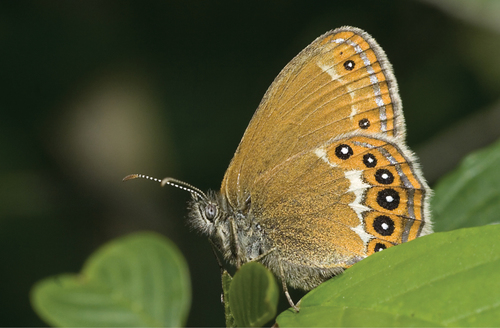
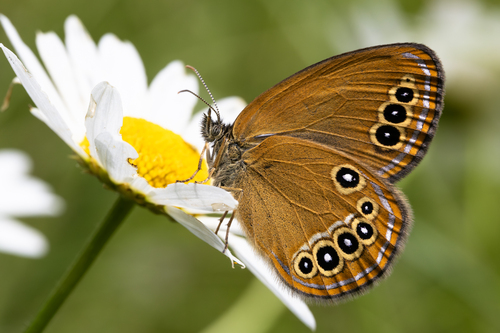
Coenonympha oedippus Fabricius, 1787 has synonyms including oedipus O., geticus Esp., and pylarge Hbn. The nymotypical form has no markings on its dark sooty brown upperside. Its underside is rusty brown washed with yellow: the hindwing bears one ocellus before the apex, and a straight row of pale-edged ocelli before the distal margin. This species occurs very sporadically across Central Europe, including Belgium, France, Northern Italy, Austria, and Hungary, and can also be found in Southern Russia and the Ural Mountains. The aberration miris F. occurs alongside the nymotypical form, and has an increased number of enlarged ocelli on the underside of the forewing. The subspecies amurensis Rühl [Heyne] is considerably larger than the nymotypical form, has particularly dark colouring on the upperside, and bears a very distinct metallic line on the underside; it is found in Eastern Siberia, especially Amurland. The subspecies annulifer Btlr. is larger than amurensis, with strongly enlarged ocelli on the underside that are sometimes elongated transversely; it occurs in Japan. The larva is pale green with a dark dorsal line and a light lateral stripe, and has a dark olive-green head. Larvae develop from July through May on reeds, and are also reported to feed on Iris. The pupa is yellowish green, with brownish capital processes and yellowish wing cases that have pale borders. Adult butterflies are on the wing in June and July. They have a hopping flight, and inhabit damp meadows, especially those that are occasionally flooded. Within these habitats, they prefer stony hillocks. Adults are generally not numerous at their flight sites, and these sites are not always accessible because they are often located in swamps.