About Coenonympha leander Esper, 1784
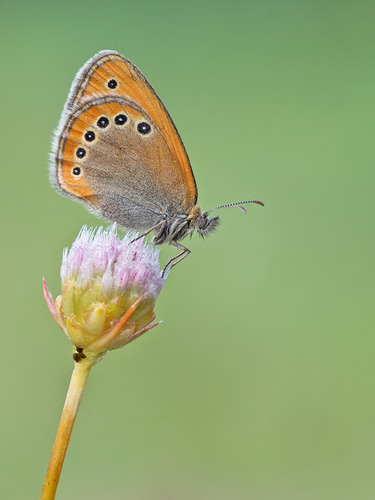
Coenonympha leander Esper, 1784, as described in Seitz: The upperside of the male is almost identical to that of Coenonympha arcania. The male forewing is yellowish red, edged with black, while the male hindwing is dark sooty brown, with ocelli faintly shining through from the underside. Females are rather paler, and have a narrower margin on the forewing. The underside of the wings is yellowish brown; the hindwing is tinged with greyish green, and marked with 6 similar ocelli. The ocellus located at the anal angle is sometimes double. This species ranges from Hungary through Bulgaria to the Black Sea, and is also found in the Crimea, the Ural and Volga districts, Asia Minor, and Persia. The darker form subspecies obscura Ruhl, originally from Armenia, is smaller and overlaid with dark colour, which makes the upperside appear uniformly sooty brown. The taxon iphioides Stgr., originally recorded from Castilia and collected near San Ildefonso, is now recognized as the separate species Coenonympha iphioides Staudinger, 1870. For this taxon, the upperside is similar to that of Coenonympha iphis, but the ocelli on the underside of the hindwing are very large and complete, touching each other along their outer borders. The thin black edge of the wing on the underside, which holds the pale fringes, contrasts strongly with a pale ochre-yellow marginal band that is proximally limited by the metallic line. This species has one generation per year. Adults have been recorded on wing from May to June, and from May to August across its range. The larvae feed on species of the grass genera Poa, Melica, Anthoxanthum and Lolium.