About Coenonympha iphis (Denis & Schiffermüller), 1776
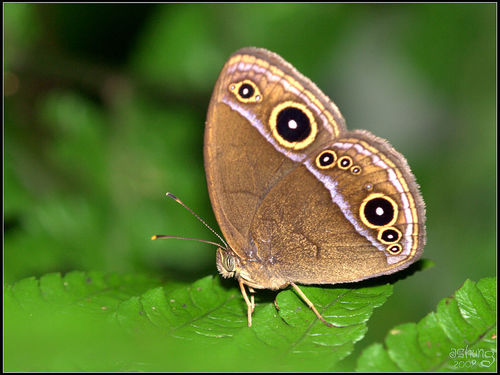
This species, scientifically named Coenonympha iphis (Denis & Schiffermüller), 1776, is described in Seitz's work under the name C. iphis H. l., with synonyms amyntas Btlr. and mandane Ky. On the upperside, the disc of the male forewing is tinted copper-brown, while the female forewing disc is yellowish brown. This base color can be darker in the aberration subnigra, or lighter in the aberration pallida. The hindwing upperside is uniformly blackish brown. The underside of the forewing has no ocelli at all, and only rarely bears a small, pale apical ocellus. The underside of the hindwing has a small number of scattered, reduced ocelli. Beyond the middle of the hindwing underside are 2 large, irregular, white sinuous patches, which can be separate or thinly connected; this feature allows the typical nymotypical form to be recognized immediately. The species is distributed across Central Europe, much of Northern Europe, and North and Central Asia, ranging from England and Belgium to the Pacific Ocean, and from Finland and Livonia to Dalmatia. Aberration anaxagoras Assmus occurs singly in Central Europe and is common in Eastern Europe; in this form, the metallic line on the underside is absent, and the hindwing ocelli are further reduced. The subspecies or form iphicles Stgr. (= heroides Christ.) has very regular, distinct hindwing ocelli, which also appear as brownish rings on the upperside, similar to Coenonympha hero from Central Asia. carpathica Horm. is a smaller mountain form found in the Carpathian Mountains, in which the hindwing ocelli are completely or almost completely gone. mahometana Alph. also has no ocelli, or at most a few white dots where ocelli would normally be. Additionally, its upperside is uniformly soot-brown, and its entire underside is dusted with white; it is found in the Tian-shan Mountains. Aberration iphina Stgr. is a Central Asian form where the underside ocelli are bordered with brown, and it almost certainly does not occur as the only form of the species anywhere. The larva is dull green with a blue-green head, a dark dorsal stripe, a pale lateral stripe, and a red anal fork. Its spiracles are yellowish red. Larvae develop on grasses until May. The pupa is green, with white spots on its abdomen and dark-edged wing cases. Adult butterflies are on the wing in June and July, and are typically found on grassy woodland roads and in damp meadows. The species is not rare, though large groups of individuals are not often seen together. Large-bodied females rarely fly more than 1 or 2 feet above the ground. When disturbed, adults usually fly only a few paces, follow the direction of the local road, and settle back into the grass. Larvae feed on a variety of grasses.