About Coenonympha hero (Linnaeus, 1761)
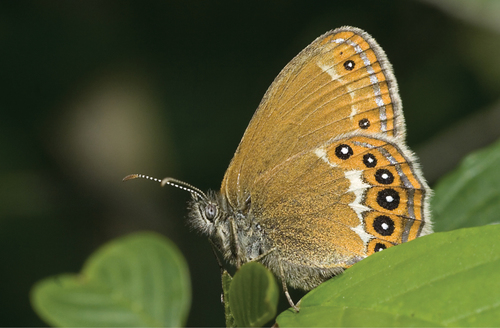
Coenonympha hero (Linnaeus, 1761) resembles Coenonympha arcania. As described in Seitz, its upperside resembles the smaller, similarly dark Coenonympha oedippus, but two or three ocelli shine through from the underside of its hindwing as yellowish brown rings. On the underside, the ocelli are surrounded by orange rings, with a straight white line on their basal side that thickens into knots at the veins. The species is found across Northern and Central Europe, the whole of Northern Asia, ranging from Sweden to the Alps, and from Belgium eastward to the Pacific Ocean and Japan. Several forms and subspecies have been recorded. The aberration ab. stolida Schilde from Scandinavia is smaller and darker, with a white distal band on the underside of its forewings. Subspecies ab. perseis Led. (= sibirica Stgr.) (48a) occurs alongside the nymotypical form in Eastern Asia, and also flies alone in some local areas; in this subspecies, the white band before the row of ocelli on the underside of the hindwing is much widened. Fruhstorfer separated larger Hokkaido specimens from this subspecies as the new subspecies neoperseis. In the Belgian recorded aberration ab. areteoides Fol., the ocelli on the hindwing are underdeveloped and no longer distinct. The pale green larva feeds on lyme-grass (Elymus) and wood-grasses. In Europe, adult butterflies are active in June and July; Graeser notes there are two broods per year in Eastern Asia. Adults inhabit deciduous woodlands and meadows overgrown with bushes. Compared to paler Coenonympha species, C. hero flies higher in the air, and slightly resembles small Erebias. They usually occur singly and only in very localized areas, so it is uncommon to catch more than a few specimens in a single day. The overall distribution of Coenonympha hero includes Central Europe, Northern Europe, and the North Palearctic, ranging from the Urals east to Mongolia, Korea, and Japan.