About Coenonympha amaryllis Cramer, 1782
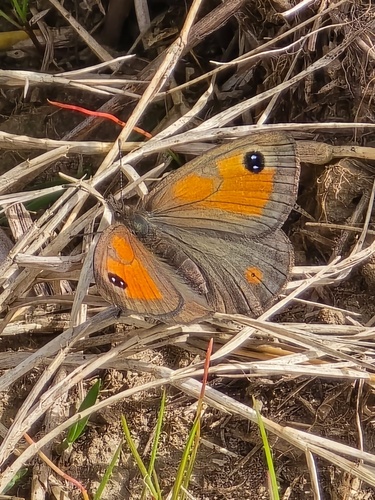
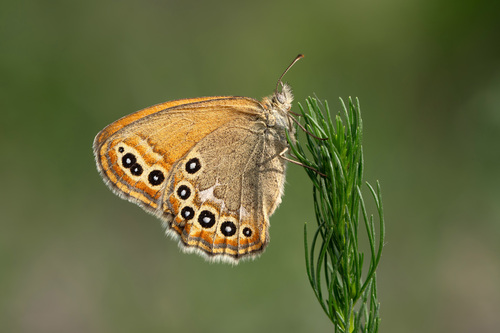
Coenonympha amaryllis Cramer, 1782, as described by Seitz, has a uniformly sandy yellow upperside matching that of C. pamphilus; the distal margin is sometimes slightly shaded, an effect especially common in females. The underside is pale honey-yellow, with the hindwing washed in greyish green; a faint line crosses the disc of the forewing. Rows of ocelli, which vary widely in their level of development, are positioned before the distal margin. Ocelli are most distinct in the form accrescens Stgr. from North China and Korea. This form, which is especially common around Pekin (where specimens can be seen flying in gardens, yards, and even in the streets), has 3 or 4 large, nearly similar ocelli with metallic centres on the forewing underside, and 6 on the hindwings. These ocelli appear as heavy black spots or small rings on the upperside. The originally described form, amaryllis Cr. (= amarillis Hbst.) (48 g), occurs across Siberia and Mongolia, from the Ural to the Amur. It still bears the full number of ocelli, but these ocelli are rather smaller, and only a few shine through to the upperside as minute black dots. For the forma rinda Men. (48 g) from Central and Eastern Siberia, the black ground of the ocelli has almost disappeared, leaving the ocelli very pale, and the entire underside of all wings is strongly dulled with grey. In the forma evanescens Alph., found in Amdo, the ocelli on the underside are nearly gone, leaving only a few traces; no pupils can be seen shining through on the upperside, and the metallic line on the underside is also absent. Alpheraky designated small specimens from Ordos with particularly washed-out underside markings as the forma ordossi. Adult butterflies are active on the wing in June and July; they are common and prefer to settle on sandy places, stony mountain roads, or field paths. Form accrescens also occurs in Ussuri, Russia, in addition to North China and Korea. Form rinda is found in central and eastern Siberia. Form borisovi occurs near Lake Baikal. The species' full range extends from the Southern Urals through the steppe and forest-steppe zones of Southern Siberia and Kazakhstan to the Upper Amur Region, Primorye, and China, reaching north as far as the Kolyma basin. The species inhabits forest-steppe and northern steppe landscapes.