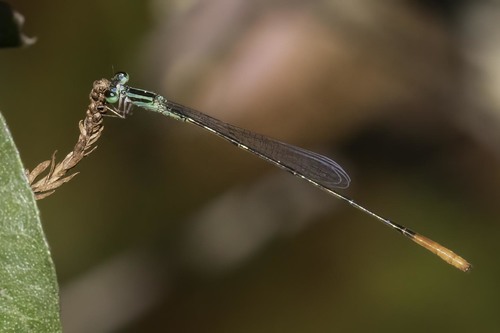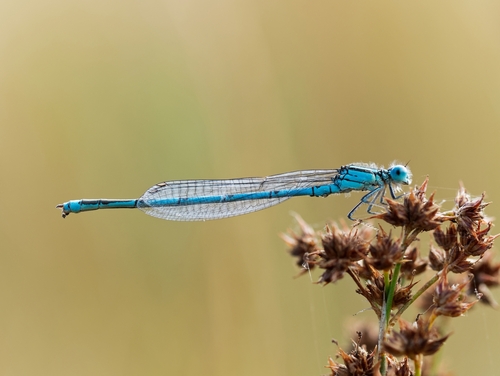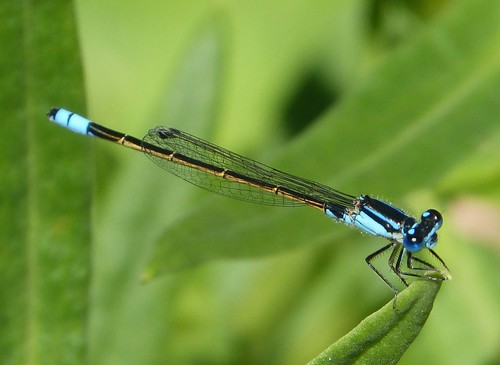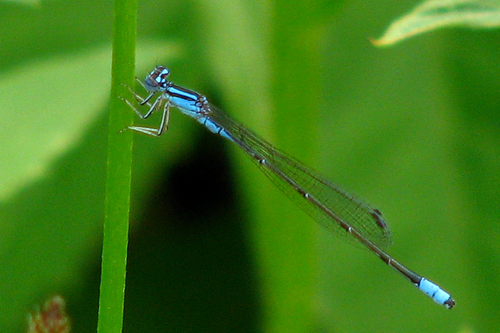
About Coenagrion ornatum (Selys, 1850)
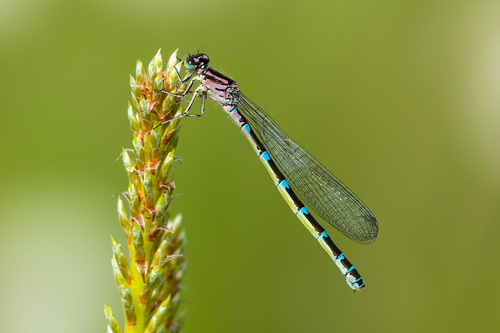
Description: Adult ornate bluets reach a total length of 30 to 31 mm, with an abdomen length of 20–30 mm and a wingspan of 17–24 mm. Their base body color is blue with black markings, which matches the appearance of other coenagrionids. Males can be identified by a marking on the top of the second abdominal segment (S2) that resembles a stalked wine glass or a trident, though this marking is not always fully developed. From segments three up to S7, there are pointed markings that look like spears. The eighth abdominal segment is entirely blue, with at most two very small black spots. Females have darker abdomens, but always have some blue coloring on the proximal half of each segment. This feature is similar to brighter female azure damselflies, which can be distinguished by three forward-pointing black spires; female ornate bluets only have a central spire. Males are very similar in appearance to male southern damselflies, and can be told apart by the serrated hind edges of the eye-spots on the top of the head, plus fine differences in abdominal markings. The adult flight period is short: adults fly during summer, from May to July, or into mid-August. Habitat and distribution: This species breeds in shallow, unshaded, slow-flowing streams with moderate plant growth. It does not occur in water bodies with densely overgrown banks. Most of the known localities for the species in Europe are along ditches in agricultural areas, where banks are regularly mowed and stream bottoms are cleaned. The Balkans is the central distribution area of Coenagrion ornatum, with only a few larger isolated populations to the west, specifically in the Danube river valley in Bavaria and in central France. Because of this distribution pattern, it is considered the eastern counterpart of the southern damselfly. The ranges of these two species overlap in Central Europe. The ornate bluet is moderately common in the Balkans, even though its local populations there are relatively small. Water pollution is causing a noticeable population decline in other parts of Europe. The species' distribution range extends east across Anatolia and Iran to south-eastern Turkmenistan, where it lives at higher altitudes, as lowlands in this region are too dry for it to survive. It is also not found on Mediterranean islands.