About Coelognathus helena (Daudin, 1803)
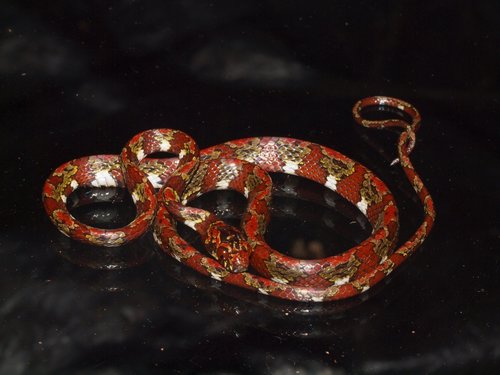
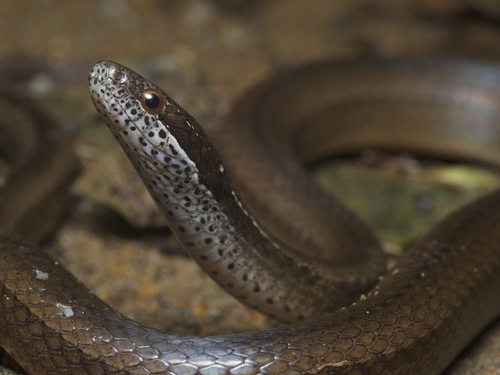
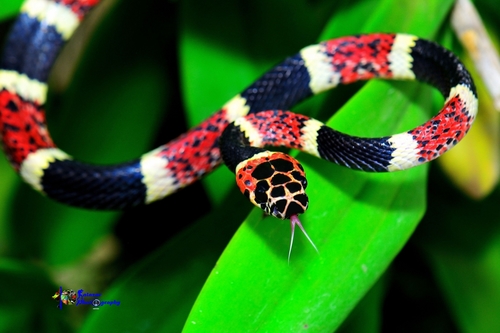
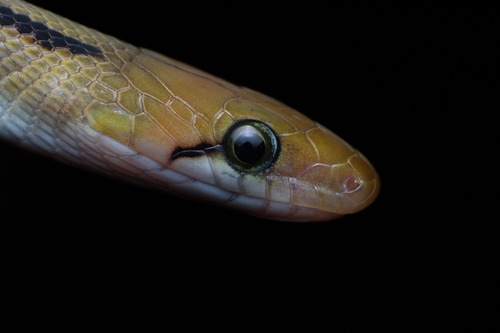
Coelognathus helena (Daudin, 1803) has a distinct scalation pattern that follows the standard terminology used for snake scales. Its rostral scale is slightly broader than it is deep, and it is visible when viewed from above the head. The suture between the internasal scales is much shorter than the suture between the prefrontal scales. The frontal scale is the same length as the distance from this scale to the tip of the snout, and it is shorter than the parietal scales. The loreal scale is somewhat longer than it is deep. There is one large preocular scale and two postocular scales. Temporal scales are arranged in a 2+2 or 2+3 pattern. There are 9 upper labials, rarely 10 or 11, and the fifth and sixth upper labials, or the fourth, fifth, and sixth, extend into the eye socket. Five or 6 lower labials make contact with the anterior chin shields. The anterior chin shields are as long as, or slightly longer than, the posterior chin shields. At midbody, dorsal scales are arranged in 23 to 27 rows; they are smooth, or weakly keeled on the posterior body and the tail. There are 220 to 265 ventral scales, the anal plate is undivided, and there are 75 to 94 subcaudal scales. Juvenile C. helena are pale brown on the upper surface, with black crossbands, each of which encloses four to six white ocelli. Adults are darker brown, with a transverse row of squarish black spots, or have more or less faint traces of the juvenile color pattern. There is a vertical black streak below the eye, and an angled black streak behind the eye. Some individuals have a white collar with black edges; others have two black longitudinal streaks on the head; and others show intermediate patterns for this head marking. The underparts are yellowish, with or without a small number of tiny black spots, and sometimes have a more or less distinct festooned marking along each side. Adult C. helena can reach a total length of 4.5 feet (1.4 meters), which includes a tail that is 10 inches (25 centimeters) long. The geographic range of C. helena covers Sri Lanka, southern India, Shangla district in Pakistan, Nepal, and Bangladesh. Its type locality is "India: Vishakhapatnam", as recorded by Daudin in 1803. The species' preferred natural habitat is forest, at altitudes ranging from sea level up to 2,500 meters (8,200 feet), but it is also found around human residences. C. helena is oviparous. Females lay eggs year-round, and clutch size ranges from 6 to 12 elongated eggs.