About Codonopsis lanceolata (Siebold & Zucc.) Benth. & Hook.f. ex Trautv.
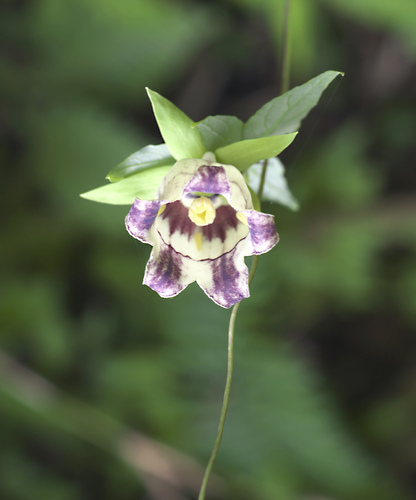
Codonopsis lanceolata (Siebold & Zucc.) Benth. & Hook.f. ex Trautv. is a hardy perennial climbing plant that reaches up to around 4.5 to 4.6 meters in height. It produces bell-shaped flowers that are purple on the inside; flowering occurs from August to September, with seeds ripening between September and October. The plant dies back to the ground each winter and regrows the following growing season. It is hermaphroditic, and is typically pollinated by bees and wasps. In the wild, this species grows in moist woodland areas on low hills or mountains at elevations between 200 and 1600 meters. It grows best in light or medium, well-drained soils with ample moisture, a neutral to slightly acidic pH, and locations with full sun to partial shade. This species can be propagated by surface-sown seeds planted in acidic soil, or by division. However, the plant does not tolerate root disturbance well, and young plants are especially vulnerable to damage from slugs. It is grown commercially in Hoengseong County, Gangwon Province, South Korea, where it forms an important part of local agriculture. Many people in South Korea also grow small amounts of the plant in their personal gardens. Along with several other species in the Codonopsis genus, Codonopsis lanceolata is used in Korean and Chinese traditional medicine. This use is likely linked to the presence of polyacetylenes, phenylpropanoids, alkaloids, triterpenoids, and polysaccharides in the plant's roots. Specifically, Codonopsis lanceolata has traditionally been used to treat bronchitis, asthma, cough, tuberculosis, dyspepsia, and psychoneurosis, and it has been credited with potential anti-cancer properties.