About Cochylis atricapitana (Stephens, 1852)
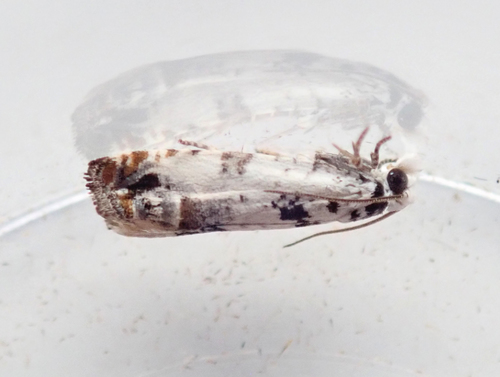
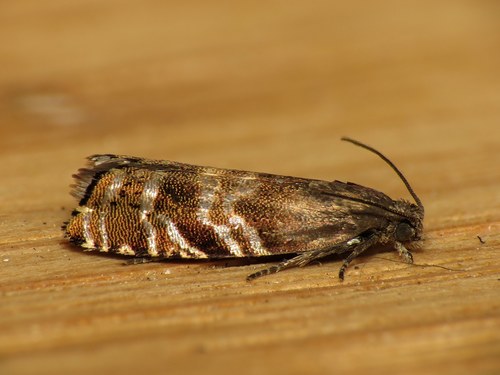
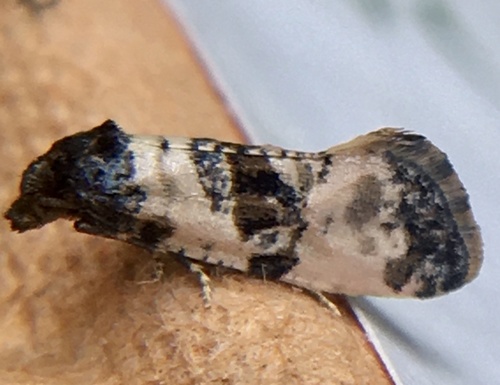
Cochylichroa atricapitana, commonly called the black-headed conch, is a moth species belonging to the family Tortricidae. This species is distributed in China (Xinjiang), the eastern Palearctic realm, and most of Europe. Its wingspan measures 10.5–13 mm. It is very similar to Cochylis dubitana, but can be distinguished by its black head and black thorax. Its forewings are white, with grey or brown basal areas; it has one cross-band slightly basal to the middle (which is often complete, unlike in many other Cochylis species) and an additional distal cross-band. The hindwings are light grey-brown and slightly angular behind the apex. The larva of this species is pale orange. Meyrick provided the following description: The head is blackish in males, and greyish-ochreous in females. The forewing costa is gently arched; the forewing ground color is rosy-ochreous-whitish, with the costa and dorsum strigulated with blackish; it has a small dark ashy-fuscous basal patch, a costal spot touching this patch, a very irregular median fascia, and a narrow terminal fascia that is dilated or furcate on the costa; the cilia are brown with extensive black markings; there is a pale greyish-ochreous cloud above the tornus. Male hindwings are whitish-grey and strigulated with grey, while female hindwings are solid grey. The larva is pale yellow, with a faint reddish tinge on the upper side; the head is light brown, and the second body segment's plate is faintly brownish. Julius von Kennel provides a full formal description of the species. There are two generations per year, with adults active on the wing from May to June, and a second generation in August. This species was formerly classified within the genus Cochylis, but was moved to the redefined genus Cochylichroa in 2019 following a phylogenetic analysis.