About Cochlearia officinalis L.
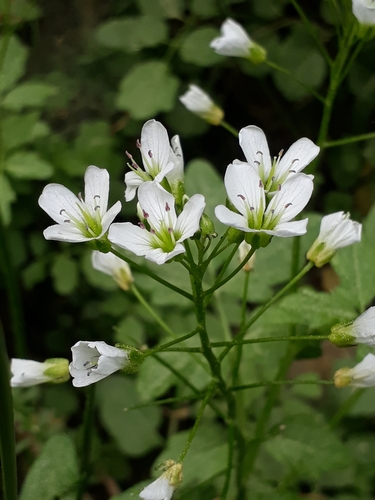
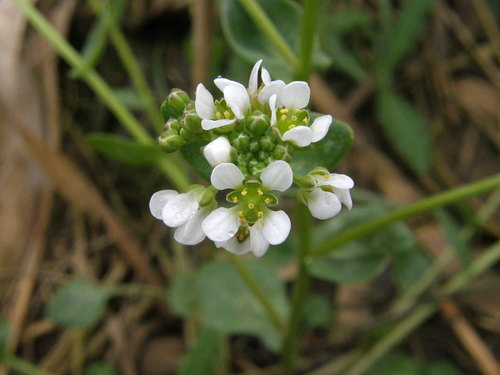
Cochlearia officinalis L. is a biennial or perennial plant that reaches a height of 10 to 50 cm (4 to 19+1⁄2 inches). It has hairless stems and long-stalked fleshy leaves; these leaves are typically heart or kidney shaped, and the leaves on lower stems form a rosette around the plant’s base. This plant blooms from May to August, producing small flowers that are either white or lilac, with four daisy-like petals. Its small, round, reddish-brown spherical seeds ripen from July to September. The flowers are hermaphrodite, and the plant is self-fertile. Cochlearia officinalis is native to temperate Europe. Its natural range covers Eastern Europe (the Arkhangelsk, Komi, Murmansk and Nenets regions of the Russian Federation), Central Europe (Belgium, Germany, Netherlands and Switzerland), Northern Europe (Iceland, Denmark, the Faroe Islands, Finland, Ireland, Norway, Sweden and the United Kingdom), and Southwestern Europe (France). It has also naturalised in other parts of Europe including Italy and Spain. It grows in coastal and mountainous regions of Europe, including the Alps. In Ireland, it prefers growing in saltmarshes, coastal cliffs and walls, and rocky, muddy seashores. In Northern Scandinavia, it grows on gravel beaches, in beach cliff crevices, and in salt marshes. Its flowers are pollinated by bees, flies, and beetles. The plant attracts wildlife and tolerates frost. Because it contains Vitamin C, it was historically used by herbalists as a treatment for scurvy. Nicholas Culpeper wrote of scurvygrass in his book Complete Herbal that its main benefit is for people affected by scurvy, and that it has excellent effects in cleansing the blood, liver and spleen when the juice is taken on an empty stomach in a cup of drink every spring morning. Dried bundles or distilled extracts of the plant were carried aboard ships, and its strong bitter taste was usually hidden by mixing it with herbs and spices. Scurvygrass drinks and sandwiches were popular in the United Kingdom until the mid-19th century, when citrus fruits became more widely available. Its leaves were used to make a beer called scurvygrass ale, which is still occasionally remade as a craft ale today.