About Cochlearia groenlandica L.
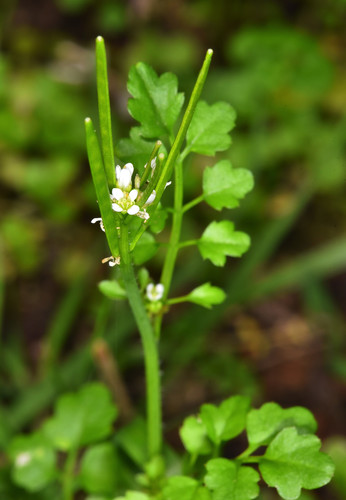
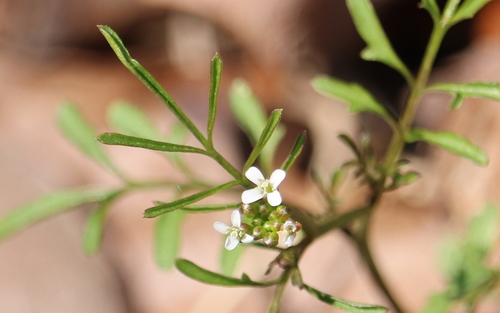
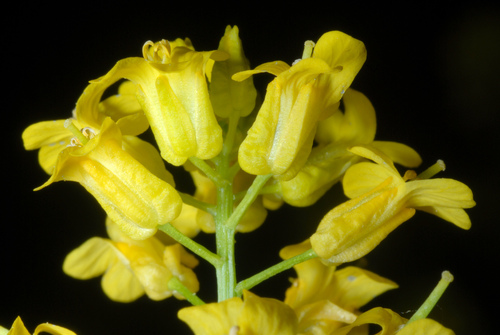
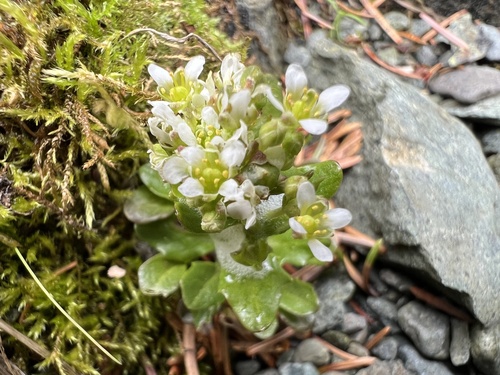
Cochlearia groenlandica, commonly called polar scurvygrass, grows as solitary plants, each with a single root and a branched caudex at ground level. It is a biennial to short-lived perennial, living between two and five years. In its first or second year of growth, it produces leaf rosettes—circular leaf arrangements that sit at ground level. Flowering takes place in the final year of the plant's life, after which the rosette leaves die, but the stems remain standing until seeds are fully mature. Each plant produces a small number of stems, usually branched towards their tips. Stems range in length from 1 to 40 centimeters (0.4 to 15.7 inches), but most commonly grow between 5 and 30 cm (2 to 12 inches). Stems may grow straight upward, or be decumbent, growing along the ground and curving upward only at the tips. Basal leaves attach to the caudex via petioles (leaf stalks) that measure 0.2 to 10 centimeters in length. Basal leaf blades are deltate to ovate in shape, 0.3 to 2.5 cm long and 0.2 to 2 cm wide. Cauline leaves (leaves growing on the stems) also grow on petioles, but these petioles become shorter closer to the stem tips, and leaves may attach directly to the stem at the tips. Cauline leaves measure 0.4–2 cm long by 0.1–1.5 cm wide. The inflorescence is a raceme, an unbranched arrangement of flowers that attach to the main stem via shorter individual stalks. Each flower has four petals and four sepals, and measures 3 to 6 millimeters in diameter. Petals are most often white, but may occasionally be pale violet. Flowering occurs between June and August. The plant produces numerous seeds that germinate easily. It reproduces only by seed, and its flowers are rarely visited by insects. Polar scurvygrass has a circumpolar range, and is present on all lands surrounding the Arctic Ocean, across all major Arctic regions. Across the Arctic, it is native to Canada, Greenland, Iceland, the Faroe Islands, Norway, Svalbard, Russia, and the United States. In the United States, it grows mainly in Alaska, but also occurs on the Olympic Peninsula in Washington state, on sea bluffs in Coos and Curry counties, Oregon, and on offshore rocks in far northern California's Del Norte County. In Canada, it is part of the native flora of British Columbia, Labrador and Newfoundland, the Northwest Territories, Nunavut, Québec, and the Yukon. Outside of the Arctic, it also grows in parts of Japan. It grows in open habitats, most typically beaches, tidal flats, gravelly or sandy ground, and mudflat bird nesting sites.