About Cochemiea poselgeri (Hildm.) Britton & Rose
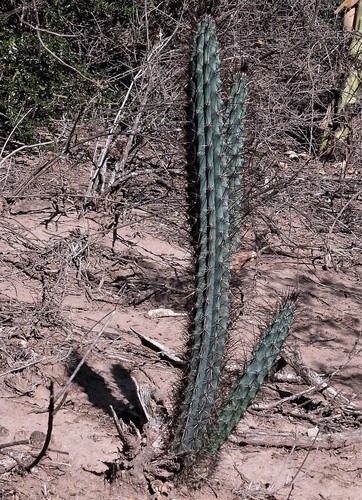
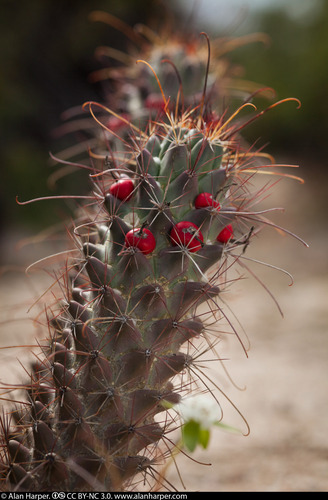
Cochemiea poselgeri grows in branching clusters from its base, forming large groups. Its shoots are cylindrical, growing up to 2 meters long and 4 cm (1.6 in) in diameter, and often hang over rocks. Its triangular tubercles (warts) are slightly rounded at the top and spaced apart. Axillae are woolly and bear a few bristles. Areoles are white and woolly; they hold one hooked central spine that is 1.5 to 2 cm (0.59 to 0.79 in) long, and up to 8 radial spines that are 1 centimeter long, brown with white tips. The flowers are red, 3 cm (1.2 in) across, with wavy crooked edges. Fruits are red and range from spherical to broadly elongated, with a diameter of 6 to 8 mm (0.24 to 0.31 in). Cochemiea poselgeri is endemic to Baja California Sur, Mexico. It is a relatively common species, found from San Ignacio south to the Cape region, and also occurs on a number of adjacent islands in the Gulf of California. This species grows in the Vizcaino Desert, Gulf Coast Desert, Magdalena Plains, and Cape lowland ecoregions. It can be found growing on flat sandy areas, on rocks, and hanging off cliffs and ridges, usually at elevations between 0 and 120 meters. It is associated with the following species: Cochemiea fraileana, Cochemiea schumannii, Cochemiea dioica, Lophocereus schottii, Stenocereus gummosus, Echinocereus brandegeei, Echinocereus barthelowanus, Pachycereus pringlei, Pachycereus pecten-aboriginum, Stenocereus thurberi, Ferocactus townsendianus, Peniocereus johnstonii, Opuntia tapona, Cylindropuntia molesta, Opuntia invicta, Cylindropuntia cholla, and Jatropha cinerea.