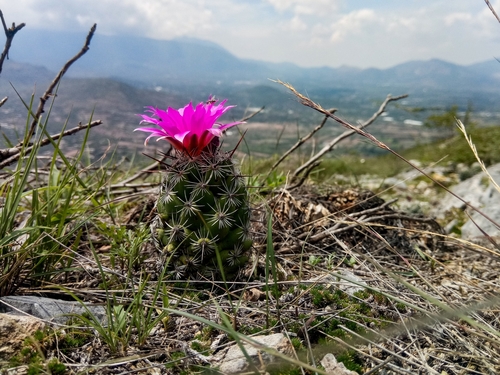
About Cochemiea conoidea (DC.) P.B.Breslin & Majure
This cactus species, previously referred to as Neolloydia conoidea, is a solitary, unbranched cylindrical cactus. It reaches a maximum height of 24 cm (9.6 inches) and a maximum diameter of 8 cm (3.2 inches). Its shoots are spherical to cylindrical, measuring 3 to 6 centimeters in diameter and 5 to 24 centimeters in height; shoot color ranges from somewhat yellowish-green to green, and shoot tips are typically whitish and woolly. Ribs on this cactus are weakly defined or entirely absent. Its prominent cone-shaped warts are 3 to 10 millimeters long and 6 to 10 millimeters wide. The dimorphic areoles are 3 to 5 millimeters in size, spaced 8 to 12 millimeters apart, and feature an areolar groove. This species usually has one straight, protruding black to reddish-brown central spine 5 to 25 millimeters long, though the central spine is sometimes absent. There are 15 to 16 radial spines. The flowers are funnel-shaped and purple-red, measuring 2 to 3 centimeters long and 4 to 6 centimeters in diameter. The flower's outer tepals are whitish with green midveins, while its inner tepals are bright pink-rose to magenta. Fruits are pale yellow-olive and contain black seeds. This cactus occurs from western Texas south to the Mexican states of Coahuila, Durango, Nuevo León, San Luis Potosí, Tamaulipas, and Zacatecas, growing at elevations between 550 and 2400 meters. It grows in limestone in Chihuahuan Desert desert scrub and Tamaulipan thorn scrub, where it is found growing alongside Echinocereus longisetus subsp. delaetii, Lophophora williamsii, Mammillaria pottsii, Mammillaria lasiacantha, Pelecyphora strobiliformis, Echinocactus platyacanthus, Ferocactus pilosus, Stenocactus crispatus, Myrtillocactus geometrizans, Thelocactus hexaedrophorus, Coryphantha erecta, Coryphantha octacantha, Stenocereus dumortieri, Cylindropuntia tunicata, Cylindropuntia imbricata, Opuntia streptacantha, Agave salmiana, Agave lechuguilla, Agave stricta, Euphorbia antisyphilitica, Hechtia glomerata, and Yucca filifera.