About Cochemiea armillata (K.Brandegee) P.B.Breslin & Majure
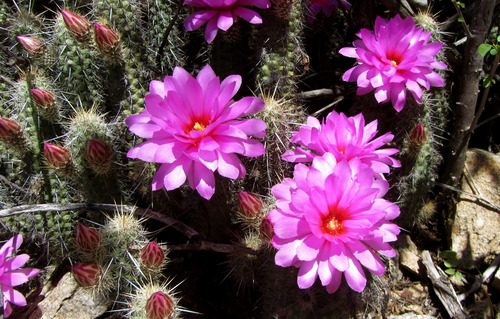
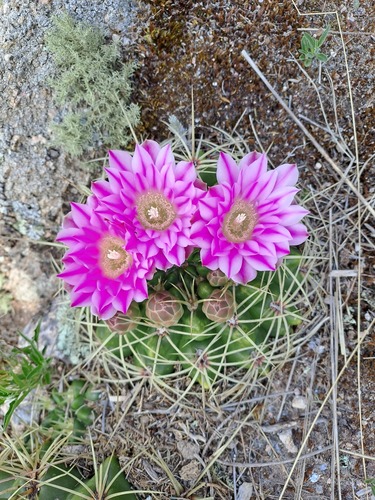
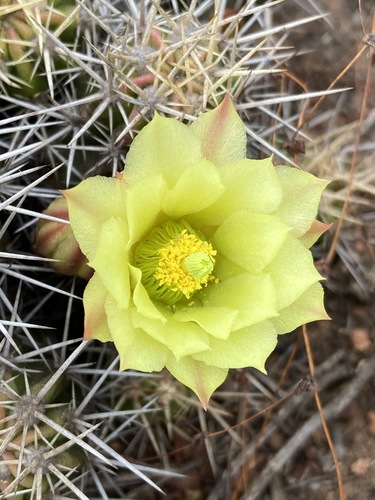
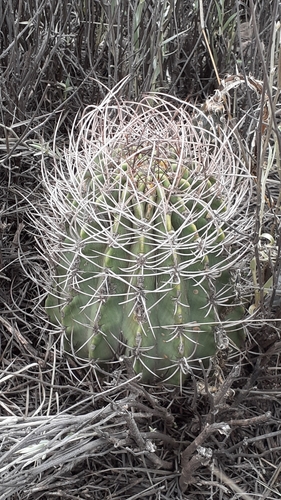
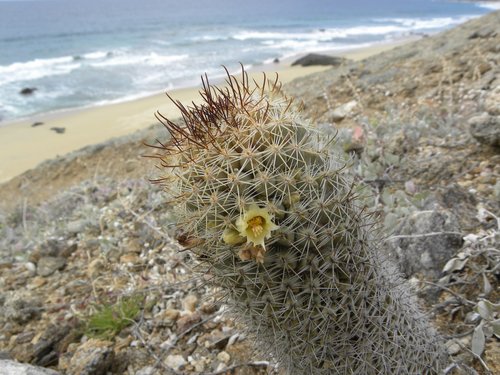
Cochemiea armillata initially grows as a solitary plant, but later forms groups. The plants are slender and cylindrical, reaching up to 30 cm (12 in) in height and 4 to 5 cm (1.6 to 2.0 in) in diameter. Mature clumps typically have 3 to 12 stems, which emerge at or sometimes above the base height. This species has firm, blue-green, conical to cylindrical warts, and does not produce milky sap. Its axillae are covered with wool and bristles. Each areole has 1 to 4 strong, yellowish-gray central spines that darken as they age, are partially hooked, and measure 1 to 2 cm (0.39 to 0.79 in) long. There are also 9 to 15 thin, bristly, straight grayish white radial spines, which are 0.7 to 1.2 cm (0.28 to 0.47 in) long. The flowers are bell-shaped or funnel-shaped, pink-creamy yellow in color, 1 to 3 cm (0.39 to 1.18 in) long, and reach up to 2 cm (0.79 in) in diameter. The flower filaments are pink, with yellow anthers. The stigma is pink, and has 5 to 7 pinkish red lobes up to 5 mm (0.20 in) long. The fruits are red and club-shaped, 1.5 to 3 cm (0.59 to 1.18 in) long and 7 to 10 mm (0.28 to 0.39 in) in diameter, containing black seeds that measure up to 1 mm (0.039 in) long by 0.5 mm (0.020 in) wide. Cochemiea armillata is endemic to the state of Baja California Sur in Mexico. It is uncommonly found across most of the Cape region, from La Paz southwards. It grows in the Gulf Coast desert, the Magdalena Plains, and the Cape lowland ecoregions.