About Coccinella undecimpunctata Linnaeus, 1758
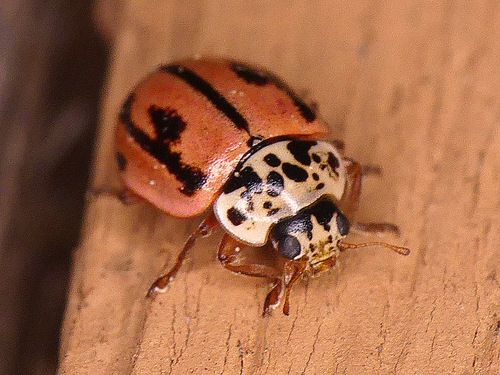
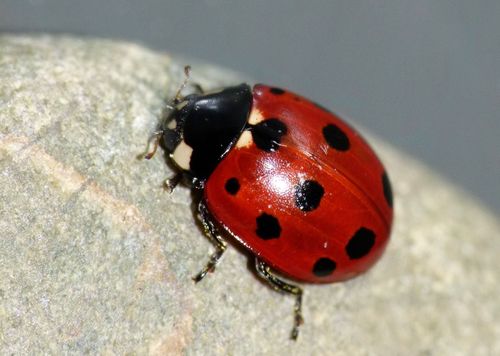
Coccinella undecimpunctata, commonly known as the eleven-spotted lady beetle, has eleven black spots on its red or orange elytra. Adult individuals range in size from approximately 4.0 to 5.0mm. While the beetle may appear to have six spots on each elytron, the single black spot located at the center of the elytra, just behind the pronotum, counts toward the total of eleven rather than being counted twice. This species is endemic to the Palearctic realm, including Europe, North Africa, European Russia, the Caucasus, Siberia, the Russian Far East, Ukraine, Moldova, Kazakhstan, Middle Asia, Western Asia, Afghanistan, Mongolia, China, Pakistan, and North India. It has been intentionally introduced to Australia to serve as a biological control agent. Reports of an introduction to New Zealand for pest control purposes have been confirmed to be incorrect. C. undecimpunctata feeds on aphids that live on grasses, and can be found in a wide variety of grassy open habitats including fields, ruderal biotopes, steppe (including Pannonian steppe), stone quarries, wastelands, dry forest edges, meadows, coastal meadows, open grassy areas, and areas near rivers. It is frequently found in biotopes containing Ammophila arenaria, and also occurs on alluvial soils, detritus, dead grass, and in biotopes containing Salix purpurea. This species is salt-resistant, and can feed on aphids that live on Atriplex tatarica and other grasses found in saline areas. C. undecimpunctata reproduces sexually, and adult individuals have a known tendency to cannibalize the eggs of other individuals or other mated pairs. Cannibalizing eggs provides fitness benefits to the cannibal: it improves the viability of the cannibal’s own eggs, increases the cannibal’s fecundity, and decreases the development time of the cannibal’s remaining offspring. These benefits differ depending on the sex of the cannibal: paternal egg cannibalism increases both fecundity and egg viability, while maternal egg cannibalism only increases egg viability. When both parents cannibalize eggs, the overall developmental time of offspring decreases, including the time to pupation.