About Coccinella novemnotata Herbst, 1793
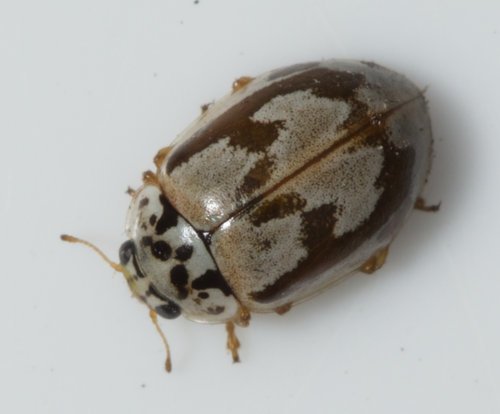
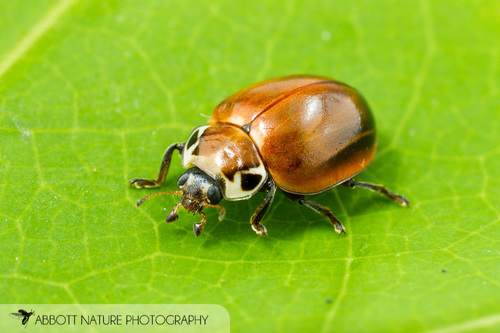
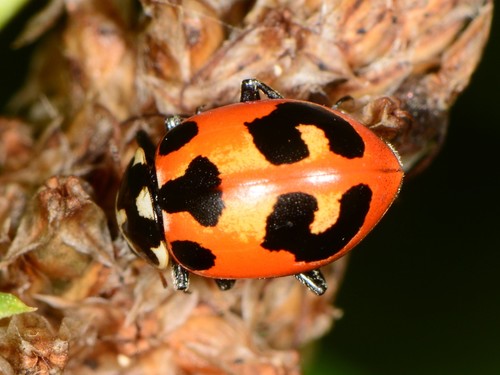
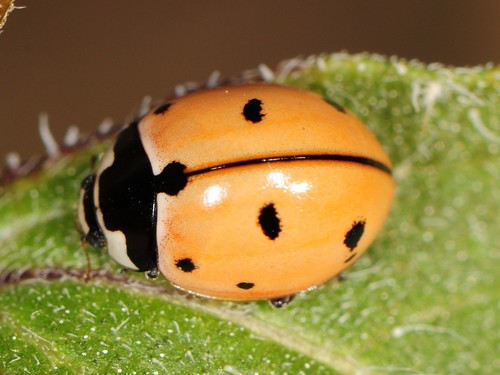
Coccinella novemnotata Herbst, 1793, commonly called the nine-spotted ladybug, can be identified by four black spots on each of its elytra, a single spot split between the two elytra, and a black suture along the gap between the elytra. Its pronotum is black, with two connected white marks at the front of its head. Adults range from 4.7 to 7.0 millimeters (0.19 to 0.28 inches) long. Elytra color can vary from yellow to orange, and individuals may have spots or lack spots entirely. Males can be distinguished from females by a spot on their anterior coxae and a stripe on their femora. Nine-spotted ladybeetles are nomadic and can survive in a wide variety of habitats across the North American continent, with their location determined by factors including aphid or other prey density, mate distribution, and seasonal availability of herbaceous material needed for breeding. Within agricultural landscapes, Coccinella novemnotata lives in cotton, alfalfa, corn, and soybean fields, and is considered a candidate for the biological control of aphids. The species can also be found in suburban parks and gardens. In more undisturbed natural settings, they occur in open areas with shrubbery and small trees (either deciduous or coniferous), meadows, prairie grassland, and riparian zones. Historically, C. novemnotata was native to North America, specifically the United States and southern Canada. In the 1970s to 1980s, it was reported to be one of the most prevalent coccinellid species in the Northeastern United States, across the continental United States, and in the southern regions of Canada. In Canada, the nine-spotted ladybeetle was once abundant from Vancouver Island to Quebec. A 1998 paper also reported sightings of the species in Guatemala and Mexico. Across its native range, C. novemnotata has become rare. It was once the most commonly collected coccinellid in the Northeastern United States until the early 1990s; the last individuals were collected from Maryland, Pennsylvania, and Delaware between 1986 and 1988, with another collection recorded in Maine in 1992. A prominent citizen science project based at Cornell University in New York has reported dozens of sightings of this rare beetle in western states of the US, with almost no sightings recorded on the eastern side of the country. In 2006, a single nine-spotted ladybug was found in Washington, DC after 14 years with no recorded finds there. In 2008, over 40 individual C. novemnotata, including more than 30 live specimens, were collected exclusively from western US states. More recently, C. novemnotata has only been collected sporadically in the Midwest and on the west coast of the United States. A 2015 Canadian report recorded larger populations in the provinces of British Columbia and Alberta, and smaller numbers of sightings in Ontario. Coccinella novemnotata is a holometabolous bivoltine species. Entry into diapause depends on photoperiod length, temperature, and prey availability. Adults enter diapause for both summer and winter, emerging from summer diapause in autumn and from winter diapause in early spring. The species reproduces in early spring, and oviposition occurs in early autumn. Adult females choose oviposition sites, and eggs are laid in clutches attached to thin branches, leaves, or other nearby surrounding material. The holometabolous life cycle of C. novemnotata progresses through four distinct life stages: egg, larva (which includes 4 instars), prepupa, pupa, and adult. Like other beetles in the subfamily Coccinellinae, C. novemnotata does not have a protective covering during the pupal stage; instead, the larval skin is shed off at this stage. The two leading causes of mortality for this species are interspecific predation and cannibalism. Larvae have been documented preying on smaller, earlier instar larvae of their own species. Adults consume eggs, pupae, and molting individuals, which are particularly vulnerable during these sessile life stages. When general prey is scarce, intraguild predation increases, as eggs are a better source of nutrients critical for larval development than the species’ main diet of aphids. Some studies show evidence that C. novemnotata experiences higher rates of egg predation by other species such as Coccinella septempunctata, as well as cannibalism of its own eggs.