About Coccinella leonina
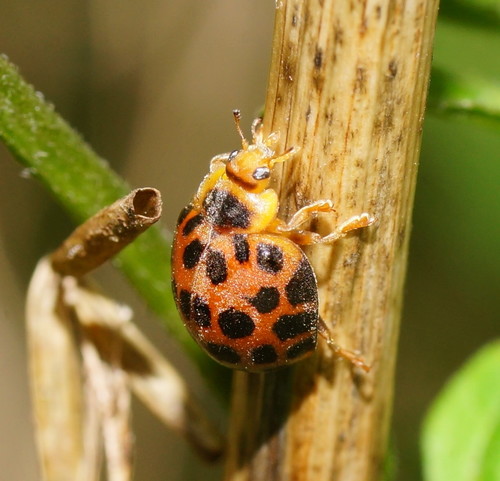
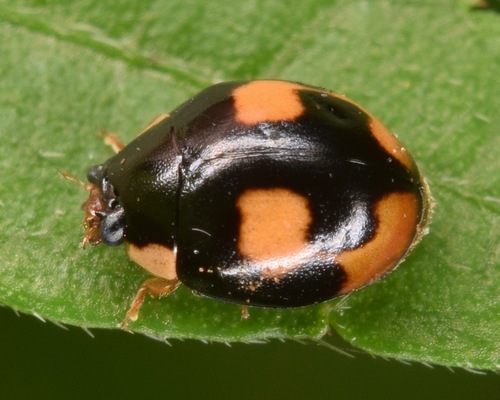
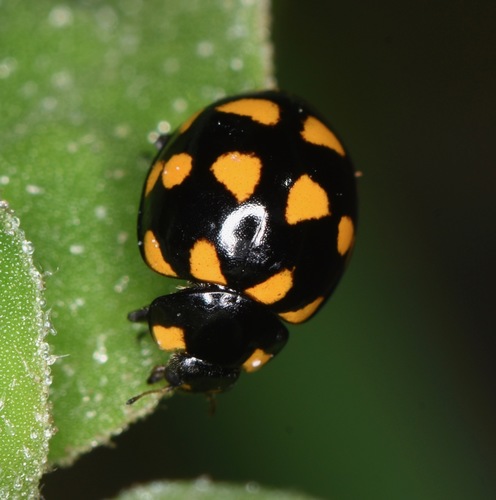
Identification: Coccinella leonina, commonly known as the orange spotted ladybird, has a black body with 16 yellow/orange spots. It has one squarish yellow/orange spot on each side above the pronotum on the thorax, plus 14 larger spots on its black elytra. At most, 1 mm of black background separates these spots. The shade of the spots can vary between individual beetles. There is also a paler blotch above the beetle's eyes, and its legs and underside are black. Its body length typically ranges from 4.5 to 5.5 mm. Its elytra are oval and widest at the middle, and the abdomen has a slightly different shape between males and females: the male abdomen is truncate, while the female abdomen is more rounded. The orange spotted ladybird is a medium-sized, hemispheric ladybird. Habitat preferences: This species occurs from sea level up to subalpine altitudes, and it is common across the areas it inhabits. It can be found in tussock grasslands and low-growing vegetation, and it is also present in native bush areas, pastures, and crops. It is very common in locations such as Banks Peninsula. Life cycle: The orange-spotted ladybird reproduces sexually, and mating typically begins around September. Females lay oval, yellow-orange eggs, usually in clusters on the underside of leaves. The development time of the eggs depends on favorable temperatures. In the days before hatching, the eggs darken to a greyish colour. A female can lay up to 30 eggs per day, and between 1600 and 3800 eggs over her lifetime. Larvae hatch from eggs by breaking the shell with sharp, circular structures called egg-busters on the back of their head. Larvae eat the same food as adult orange-spotted ladybirds, and the primary function of the larval life stage is to eat and grow. To molt its skin, a larva hangs upside down using its anal organ. The larva's skin splits along the dorsal midline. Larvae molt several times before their final, fourth molt, when a pale, soft pupa emerges. As the pupa matures, it develops a hard, patterned pupal case. During the pupal stage, some internal tissues and organs are broken down and used to form adult body parts, including reproductive organs and wings. Pupal development normally takes four to ten days, but it can take longer in colder conditions. When the adult beetle first emerges, its elytra does not have its distinctive mature pattern, and is instead matte, soft, and pale. It can take up to several months for the beetle to develop its full mature appearance. After emerging, adult beetles will either search for food, mate, or prepare to hibernate, depending on the time of year. Adult ladybirds can live from a couple of months to over one year. During winter, adults stay grouped in hidden, sheltered spots, and disperse in spring to find food and suitable locations to lay eggs.