About Cobaea scandens Cav.
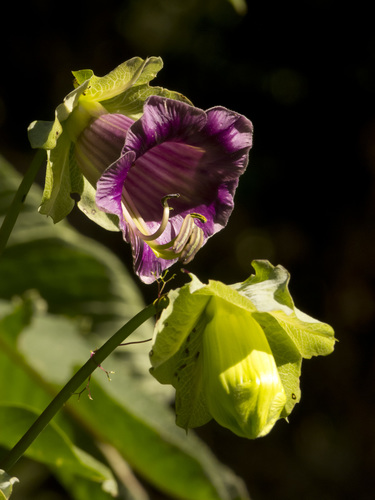
This species is a self-clinging perennial climber. Its Latin specific epithet scandens translates to 'climbing'. Its leaves measure 10 cm (4 in) long, and are made up of four leaflets plus a tendril that has small hooks to cling to supports. Its large, forward-facing flowers start out white when they open, and turn violet as they mature. In the species' native habitat, these flowers are pollinated by bats. The flowers are bell-shaped with a distinct ruff, which is where the common name cup-and-saucer comes from. Mature flowers have a scent. The plant produces capsular fruits that contain seeds. Cobaea scandens Cav. is widely cultivated for its twining growth habit and highly ornamental 5 cm (2 in) long flowers, which change color from white to purple as they mature. In temperate regions, it is most often grown as a half-hardy annual: seeds are sown with heat under glass in early spring, and the seedlings are planted outdoors after all risk of frost has passed. This species has earned the Royal Horticultural Society's Award of Garden Merit, a status that was confirmed in 2017. A white-flowered form of this species exists, known as C. scandens f. alba.