About Cnidoscolus urens (L.) Arthur
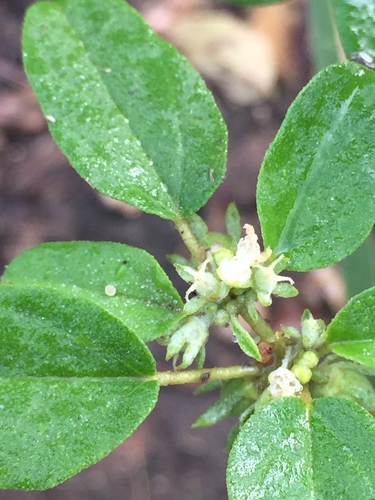
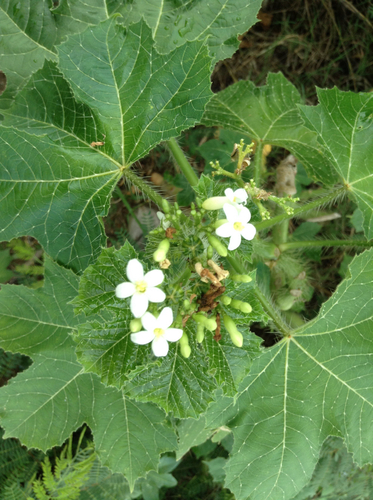
Cnidoscolus urens (L.) Arthur is a perennial stinging herb in the family Euphorbiaceae, native to tropical America. It is one of around 100 species in the genus Cnidoscolus; the genus name comes from the Greek words knidē meaning "nettle" and skōlos meaning "thorn", while the specific epithet urens comes from Latin meaning "burning". Local common names for this plant include bull nettle, spurge nettle, pringamosa, bringamosa, and mala mujer, which translates to "evil woman". This species grows an erect stem, starting as herbaceous when young and becoming woody as it ages, reaching a height between 50 and 150 centimeters. It produces large, lobed leaves, and white flowers arranged in cymes. After flowering, it forms a spiny 3-seeded capsule; the seeds are rich in fats and proteins and resemble the seeds of Ricinus communis. The carunculate seeds are typically dispersed by ants, a process called myrmecochory, attracted to the edible elaiosome on the seed. The entire plant is covered in stinging hairs. Its native range spans Central and South America, where it occurs in Costa Rica, El Salvador, Guatemala, Honduras, Mexico, Nicaragua, Panama, Peru, Colombia, and Venezuela. Cnidoscolus urens is monoecious and self-compatible. Its male and female flowers look superficially similar but differ in internal structure. During the dry season, the main pollinator is the butterfly Eurema daira, which does not distinguish between male and female flowers. Female flowers make up only around 6% of all flowers produced by the plant, produce almost no nectar, and mimic male flowers to gain attention from pollinators that gather pollen and nectar. Male flowers typically only function for one day, while unpollinated female flowers can remain functional for up to seven days. The genus Cnidoscolus was split from the Linnaean genus Jatropha based on its stinging hairs, also called trichomes. These structures are made up of a multi-cellular pedestal and a single, elongated, hollow cell with a slightly swollen tip. When touched, the brittle swollen tip breaks off at an oblique angle, the sharpened end easily penetrates skin, and the cell contents are injected into skin similar to a hypodermic syringe. The poison from these stinging hairs causes severe skin irritation that can last for several days. Eating parts of this plant causes lip swelling, facial flushing, vomiting, and even unconsciousness. Its latex is highly corrosive and can cause serious sores. A study conducted in Costa Rica found that larvae of Erinnyis ello, a moth in the family Sphingidae, trim the stinging hairs from the leaf petiole, then constrict the vessels that supply latex to the leaf, after which the larvae can safely eat the leaf.