About Cnestus mutilatus Dole & Cognato, 2010
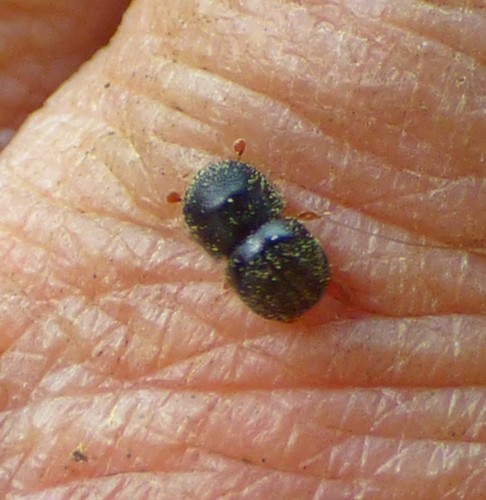
The species Cnestus mutilatus was formally described by Dole & Cognato in 2010. Adult female Cnestus mutilatus are primarily black, and are larger and more robust than most ambrosia beetles. They measure 3.4 to 3.9 mm in length, and are approximately 1.7 times longer than they are wide. This makes C. mutilatus the largest ambrosia beetle species recorded in North America. The body shape of this species is also distinct compared to most ambrosia beetles: its abdomen is shorter than the combined head and thorax, and the posterior end has a sharp slope that gives the beetle a severed or "squished" appearance. Adult males of the species are smaller and flightless. Cnestus mutilatus is native to Asia, where it has been recorded in Burma, China, India, Indonesia, Japan, Korea, Malaysia, New Guinea, Sri Lanka, and Thailand. It was first collected in traps in Mississippi, USA in 1999, and follow-up surveys confirmed it was already widely established in the state. The species has since spread across much of the eastern United States, ranging from Florida north to Pennsylvania, and west to Illinois and Texas. Like other ambrosia beetles, Cnestus mutilatus carries a symbiotic fungus that it introduces into its host plant; this fungus is the main food source for both adult beetles and their larvae. The specific ambrosia fungus associated with Cnestus mutilatus is Ambrosiella beaveri. Female beetles tunnel straight through bark and into the wood of host tree branches, attacking relatively small stems that are typically 1 to 5 cm in diameter. They enter host stems through circular holes around 2 mm in diameter. Their tunnel systems, called galleries, usually extend horizontally a short distance into the stem before branching into long vertical tunnels that can reach up to 3.8 cm in length.