About Cnemotriccus fuscatus (Wied-Neuwied, 1831)
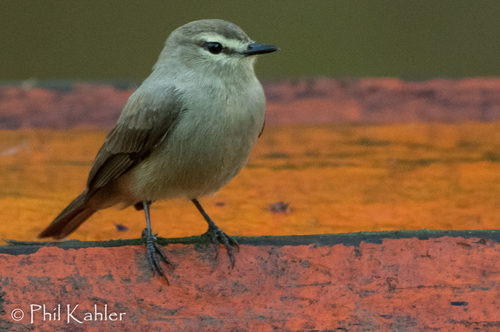
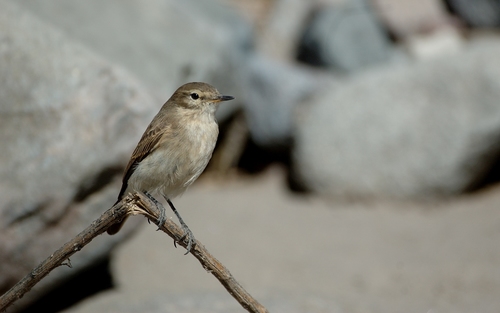
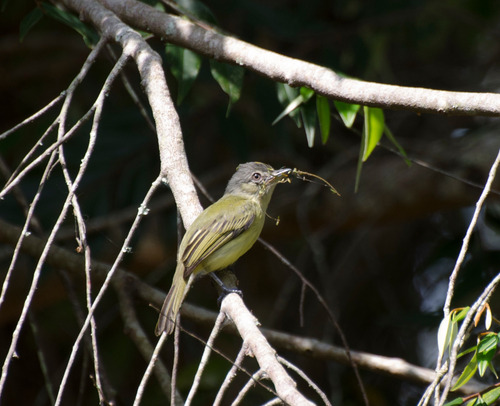
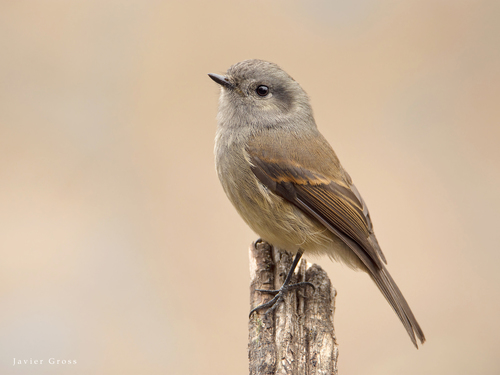
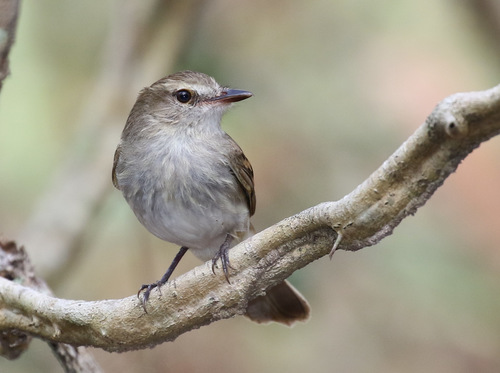
The fuscous flycatcher (Cnemotriccus fuscatus, first described by Wied-Neuwied in 1831) is 13.5 to 15 cm (5.3 to 5.9 in) long and weighs approximately 12 g (0.42 oz). Males and females have identical plumage. For the nominate subspecies C. f. fuscatus, adult males have a brown crown with a faint rufescent tint. They have dusky lores, a whitish line above the lores that extends as a supercilium, and a dusky stripe running through the eye. Their upperparts are brown with a slight rufescent tint. Their wings are dusky, with wide buffy tips on the coverts that form two distinct wing bars. Their inner secondaries have thin buff edges, and their tertials have whitish edges. Their long tail is dusky, with brown edges on each feather. Their throat is whitish, their breast is olive-gray to grayish brown, and their belly is pale yellow. They have a blackish iris, a long thin black bill with a dull pinkish base to the lower mandible, and black legs and feet.
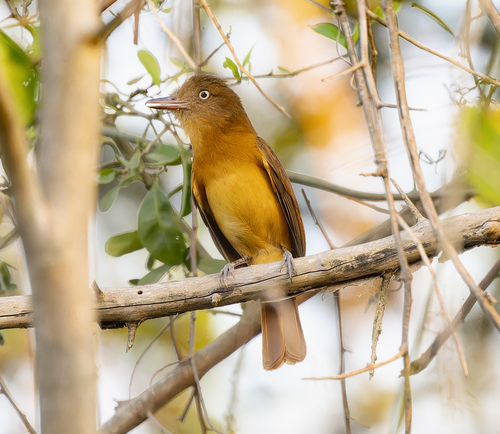
Other subspecies differ from the nominate and from one another as follows: C. f. duidae has a dark brown crown and back, a rich olive-brown breast, a pale yellow belly, and an entirely pale yellow-orange mandible. C. f. fuscatior is similar to duidae, with a dark brown crown and back, but has a less rich olive-brown breast, a somewhat yellower belly, and a completely dark bill. C. f. bimaculatus matches the nominate subspecies except for its dull brownish gray breast, white belly, and completely black bill. C. f. beniensis is similar to bimaculatus. C. f. cabanisi has two color morphs: one with grayish upperparts and a white belly, and another with brown upperparts and a yellow belly. C. f. fumosus is intermediate between the brown-and-yellow morph of cabanisi and duidae.
The subspecies of fuscous flycatcher have distinct distribution ranges: C. f. cabanisi occurs from northern and eastern Colombia into northwestern and northern Venezuela north of the Orinoco River, and also lives on Trinidad, Tobago, Monos, and Chacachacare Islands. C. f. duidae is found in central and southern Amazonas state in southern Venezuela and the adjacent upper Negro River basin in northwestern Brazil. C. f. fumosus lives in the Guianas and in Brazil north of the Amazon, from the Branco River east to the Atlantic coast. C. f. fuscatior ranges from western Apure in western Venezuela south through southeastern Colombia, eastern Ecuador, and eastern Peru, and east from these areas into Brazil south of the Amazon as far as the Tocantins River; in Ecuador, it is found mostly along the Napo River. C. f. beniensis occurs in the Pando and Beni departments of northern Bolivia. C. f. bimaculatus is found in southeastern Peru, central and eastern Bolivia, southern and eastern Brazil, Paraguay, and northern Argentina from Jujuy to Corrientes provinces. The nominate subspecies C. f. fuscatus lives in southeastern Brazil between Bahia and Rio Grande do Sul, and extends into Misiones Province of northeastern Argentina. Additionally, the South American Classification Committee of the American Ornithological Society has recorded verified sightings of the species in Uruguay.
The fuscous flycatcher lives in a range of different landscapes, and across all of its range it favors thick, shady undergrowth. Specific habitat preferences vary by subspecies: C. f. fuscatior is found in humid primary and secondary forest and woodland, especially along watercourses in landscapes such as várzea, and on river islands. C. f. duidae is mostly limited to forest growing on sandy and other nutrient-poor soils. C. f. cabanisi is often found in drier woodlands and in gallery forest in more open terrain. The species occurs mostly from sea level to 500 m (1,600 ft) in Brazil, though it can be found locally at higher elevations. In Venezuela, it occurs up to 1,350 m (4,400 ft), but is mostly found below 500 m (1,600 ft) north of the Orinoco River, and only reaches around 250 m (800 ft) south of the river. It occurs up to 1,000 m (3,300 ft) in Colombia, 400 m (1,300 ft) in Ecuador, 500 m (1,600 ft) in Peru, and 2,400 m (7,900 ft) in Bolivia.