About Clossiana euphrosyne (Linnaeus, 1758)
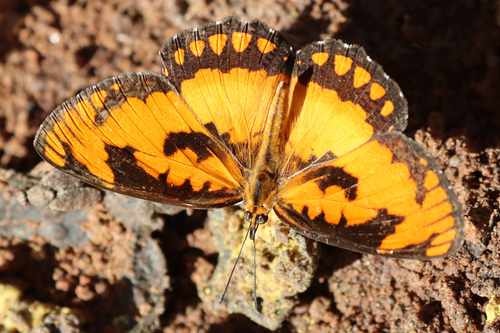
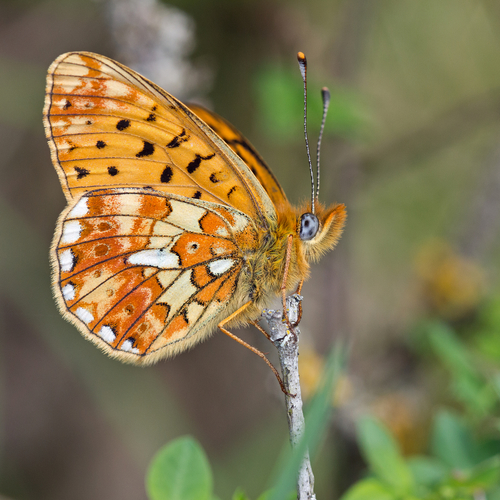
Clossiana euphrosyne, commonly called the pearl-bordered fritillary, is a butterfly species first described by Linnaeus in 1758. Adult butterflies have orange wings with black spots on the upperside, and a wingspan ranging 38–46 mm. The underside of the wings has a row of silver-pearly markings along the edge, which give the species its common name. This species is often confused with the small pearl-bordered fritillary, but can be distinguished by two key features: a triangle along its pearl border (the small pearl-bordered fritillary has black chevrons instead), and a single silver spot in the middle of a row of yellow spots. Females have darker markings and rounder wings than males. Like other fritillary species, males have special scent glands on their wings that allow females of the species to recognize them, helping males find suitable mates. Caterpillars of this species are black with white or yellow spines along their backs. In Seitz's description, the species is listed as A. euphrosyne L. (= niobe Mull.) (67h). It is very similar to related species, especially C. selene, but typical specimens are brighter red with thinner black markings. It is easily recognized by the underside of its hindwing: the base is bright brick-red, not brown like C. selene, the median band holds only one silver spot across the apex of the cell, and the incomplete silvery band in the distal area is replaced by yellow smears with no silvery gloss. Silvery marginal spots on the underside of the hindwing are only very rarely absent. The pearl-bordered fritillary is widespread across Europe, ranging from Scandinavia to northern Spain, and from Ireland eastward across the Palearctic through Russia to northern Kazakhstan. It has declined rapidly in numbers in England and Wales, plus 10 other countries, and is considered a highly threatened species. It prefers well-drained habitats with a mosaic of grass, bracken, and light scrub, including woodland clearings, recently coppiced or clear-felled woodland with bracken or oak and bramble leaf litter, hot freshly cut areas, and scrub edges such as gorse, which can provide good breeding conditions. It favors sites with abundant food plants growing in short, sparse vegetation with plenty of dead plant material, and bracken is preferred. This butterfly is a key indicator species for well-maintained open woodlands. It is one of the first butterflies to emerge in spring, making it an early sign of a healthy habitat. Its specific habitat requirements make the species particularly sensitive to environmental changes. Adult pearl-bordered fritillaries are strong fliers that prefer warm, sheltered grasslands, woodland clearings, and meadows with plentiful nectar sources. Their dependence on carefully managed landscapes highlights the importance of conservation efforts to maintain their populations. Caterpillars rely on common dog violet (Viola riviniana) and other violet species as food, and thrive in recently cleared or sunlit areas. After mating, females lay eggs singly (rather than in large groups like the marsh fritillary) on dead bracken (Pteridium aquilinum), leaf litter near violet food plants, or sometimes directly on the leaves of the food plant itself. Known host violet species are common dog-violet (Viola riviniana), heath dog-violet (Viola canina), and marsh violet (Viola palustris). The habitat mosaics this species prefers typically consist of one-third grass and two-thirds bracken. Eggs can be found on food plants from mid-May to the end of June. They are pale yellow, and hatch after 10–14 days. Their dependence on carefully managed landscapes highlights the importance of conservation efforts to maintain their populations.