About Clivia miniata (Lindl.) Verschaff.
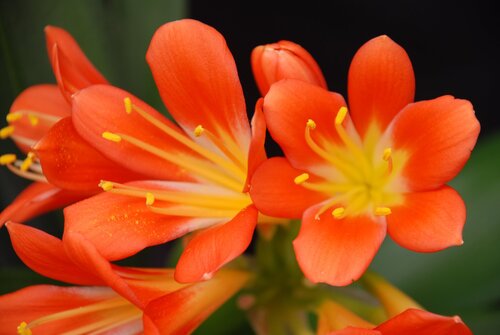
Clivia miniata (Lindl.) Verschaff. has a fleshy, mostly underground rhizome up to 2 cm (1 in) in diameter, paired with numerous fleshy roots. The rhizome produces long, arching, strap-like leaves that grow to roughly 45 cm (18 in) long, arranged in two opposing distichous rows. Its showy, funnel-shaped flowers grow in an umbel-shaped inflorescence, and come in red, orange, or yellow; they sometimes have a faint, very sweet fragrance. The fruit is a bright red spherical berry up to 5 cm (2 in) across, containing one to a few seeds. In cultivation, it is sometimes called "Kaffir lily" — a term that is considered extremely offensive in South Africa. This same derogatory name is also used for the genus Hesperantha, formerly known as Schizostylis. Clivia miniata contains small amounts of lycorine, which makes it poisonous. The genus Clivia was named after Lady Charlotte Clive, Duchess of Northumberland, who first cultivated this plant in England and provided the flowers used for the type specimen. The Latin specific epithet miniata means "cinnabar", the color of red lead, and refers to the plant's flowers. In cooler and temperate regions, Clivia miniata is most often grown as a houseplant. It can be grown outdoors in the ground year-round in USDA hardiness zones 9–11, or any location where frost does not occur, as long as the average temperature stays between 5 °C (41 °F) and 29 °C (84 °F). Like its relative Clivia nobilis, Clivia miniata has earned the Royal Horticultural Society's Award of Garden Merit. The variety Clivia miniata var. citrina also holds this award, which was reconfirmed in 2017. In warmer growing areas, it is commonly used in public plantings and shaded landscapes, valued for its attractive evergreen foliage and showy flower clusters. This clump-forming plant spreads through its rhizomes, and is naturally well suited for calm, protected growing spaces. One named cultivar is Clivia miniata 'Kirstenbosch Splendour', bred by Graham Duncan, which is featured on the cover of the 2013 Kirstenbosch centenary book.