About Clitoria fragrans Small
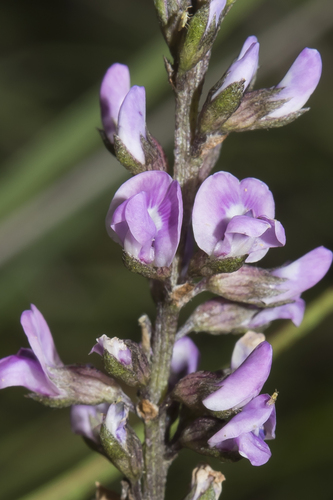
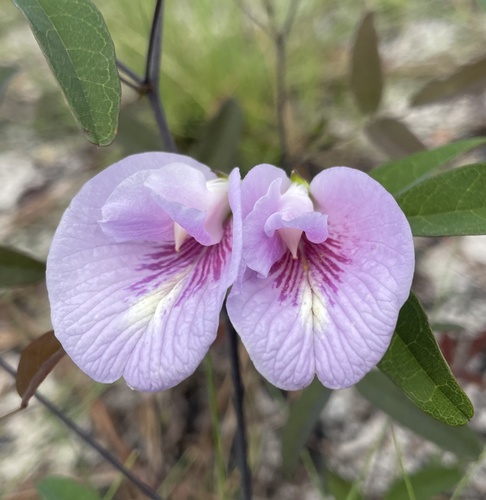
Clitoria fragrans Small is a perennial herb or subshrub that grows up to 0.5 meters tall from a woody taproot, and sometimes reaches 1 meter in height. It produces slender, purplish, slightly waxy-textured stems that bear alternately arranged leaves. Each leaf has three elongated oblong or lance-shaped, bristle-tipped green leaflets, each of which can grow up to 4.5 centimeters long. Inflorescences emerge from leaf axils, and each holds one or two fragrant blooms. Open flowers can be up to 5 centimeters long, and are mostly pale pinkish purple with darker rose-pink streaks at the center and a white spot below. Open flowers are resupinated: their reproductive parts curve around to point toward the back of the corolla, which forces visiting insects to rub against these parts to transfer pollen. This species often produces a second type of flower that is cleistogamous: it self-pollinates and does not open to form a full corolla. Cleistogamous flowers are generally more common overall, but showy open corolla flowers tend to be more common in the growing seasons following a wildfire. Both flower types produce fruit, a legume pod that can reach up to 5 centimeters long and holds up to 9 reddish seeds a few millimeters in length. The seeds have a sticky texture, and are dispersed when they adhere to animals. This species grows in undisturbed Florida scrub habitat, often in the transition zone between scrub and sandhill areas. It prefers open habitats where it is not shaded by tall woody vegetation. In its natural state, this habitat experiences periodic wildfires, a process that prevents taller vegetation from shading smaller herbs and shrubs. The plant's deeply growing taproot helps it survive wildfires and resprout afterward. It grows in dry upland areas of scrub in white, yellow, and gray sand types. This plant is known from several widely scattered populations. Many of these populations are located on protected land within Seminole State Forest, Lake Wales Ridge State Forest and National Wildlife Refuge, and Allen David Broussard Catfish Creek State Park. Many occurrences are also found on Avon Park Air Force Range, where military authorities are required to monitor the plants because the species has a federally threatened status.