About Clitocybe violaceifolia Murrill
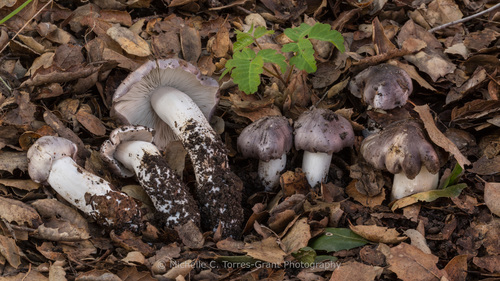
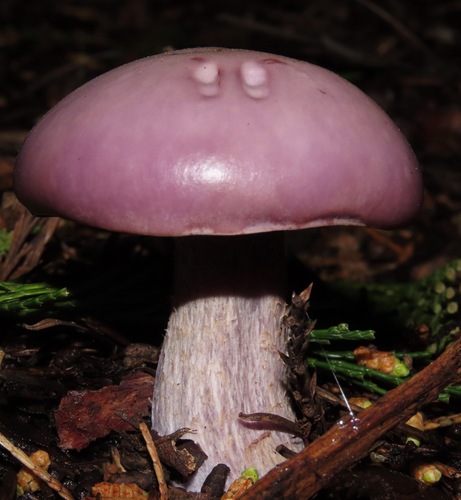
Clitocybe violaceifolia, commonly called the western cypress blewit, is a species of gilled mushroom native to western North America. It can be told apart from its cousin, the choice edible wood blewit, by its unique association with trees in the cypress plant family. California mycologist Alan Rockefeller has documented that C. violaceifolia smells like mud. While this mushroom is theoretically edible, it is widely reported to be quite unpalatable. This species was first formally described by William A. Murrill in 1913, based on a type specimen collected near Salem, Oregon by Morton E. Peck. Murrill's original description reads: "Pileus convex, somewhat gibbous, solitary, 3 cm. broad; surface slightly viscid when moist, smooth, glabrous, grayish-violet tinted with brown at the center, margin entire, slightly paler; lamellae very narrow, adnexed to slightly decurrent, rather crowded, arcuate, pale-violet; spores ellipsoid, smooth, hyaline, 7-8 X 3.5-4.5; stipe equal, fleshy, solid, smooth, glabrous, grayish-violet, mycelioid at the base, 3 cm. long, 6 mm. thick." Confirmed documented populations of the western cypress blewit occur in Oregon, California, and Arizona.