About Clitocybe glacialis Redhead, Ammirati, Norvell & M.T.Seidl
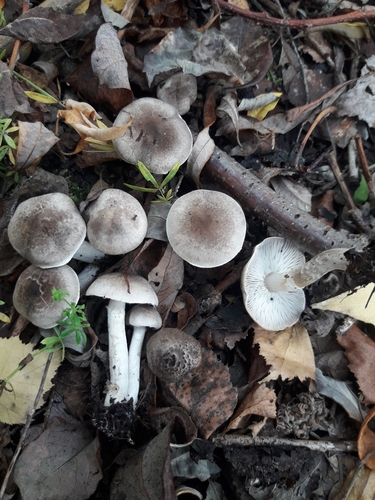
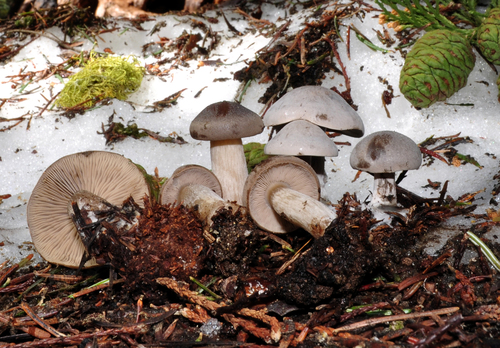
The fungus Clitocybe glacialis produces fruiting bodies with caps 2 to 6.5 cm (3⁄4 to 2+1⁄2 in) in diameter, ranging in shape from convex to flattened. The cap surface is initially a silvery-gray, described as canescent, and turns yellow or yellow-brown as it ages. Young specimens often have a whitish surface bloom that sloughs off with age. The gills are gray to dark gray, closely spaced, and attach to the stem from adnate to almost free. The stem matches the cap in color, measures 3 to 7 cm (1+1⁄8 to 2+3⁄4 in) long and 0.5 to 1.5 cm (1⁄4 to 5⁄8 in) thick, and is either cylindrical or slightly wider at the base; the base itself is covered by white strands. Clitocybe glacialis has a pleasant odor, but no distinctive flavor. For microscopic characteristics, spore deposits (spore prints) of the species are white. Microscopic examination shows spores are smooth-walled, elliptical or oblong, with dimensions of 5.5–7 by 3.5–4.5 μm. In terms of habitat and distribution, this mushroom grows at high elevations, and produces fruit bodies from late May to early August. It is classified as a snowbank mushroom because its fruiting bodies typically appear around the edges of melting snowbanks. It has been recorded in multiple locations across North America, including Idaho, Oregon, Washington, Montana, and Alberta.