About Clitocybe albirhiza H.E.Bigelow & A.H.Sm.
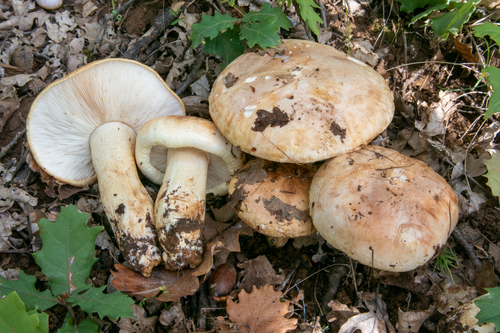
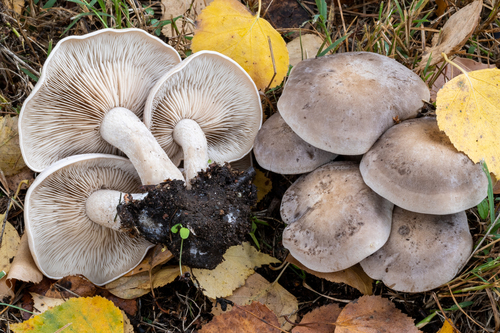
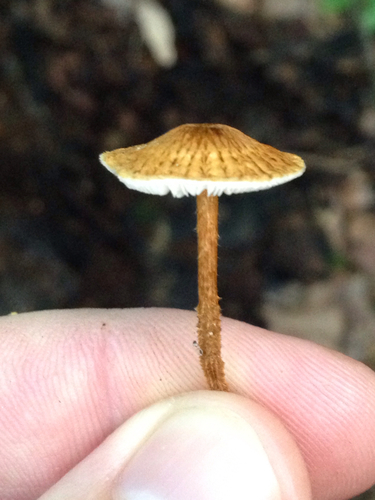
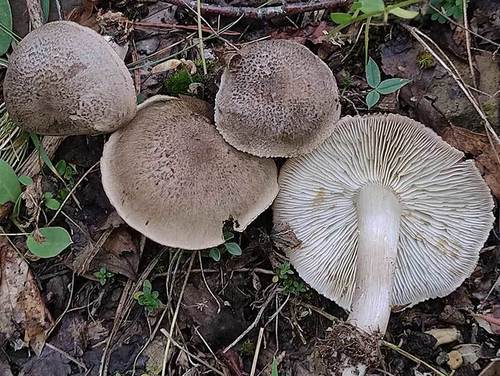
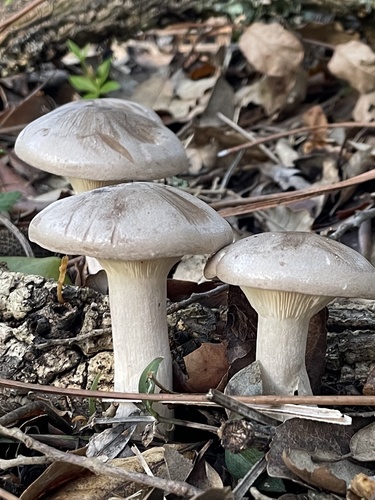
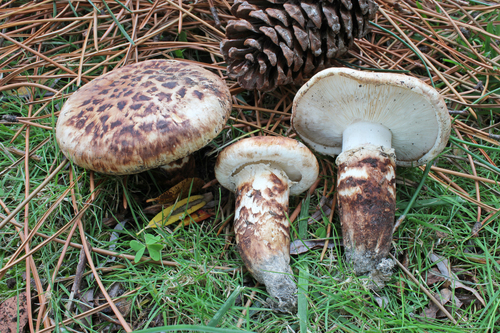
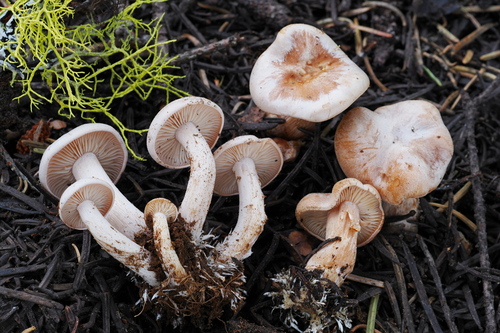
The cap of Clitocybe albirhiza is 2 to 10 cm (3⁄4 to 4 inches) across. It starts convex, then flattens out and becomes funnel-shaped as it matures. Young fresh fruit bodies are typically whitish. Mature specimens change color based on hydration: they are buff when dry, and cinnamon-buff to clay-colored when wet, often showing distinct concentric color differences. The gills attach to the stipe in an adnate to decurrent arrangement, are closely spaced, and sometimes have connecting veins between them. They are roughly the same color as the cap, or paler. The stipe measures 2–8 cm long by 0.5–2 cm wide. It can maintain a consistent width along its length, or taper at both ends. When young, the stipe is initially stuffed with cottony mycelium, and it hollows out as it matures. The stipe shares a similar color with the cap. Its texture ranges from smooth to canescent, meaning it is covered in a whitish-grey bloom, when wet, and becomes fibrillose-striate when dry. The base of the stipe has a dense cluster of whitish rhizomorphs that hold embedded needles and other forest debris. The flesh is mostly thin, except at the central disc of the cap. This fungus has a slight to unpleasant odor, a poor bitter taste, and is classified as inedible. It produces a white spore print. Its spores are smooth and elliptical, measuring 4.5–6 by 2.5–3.5 μm. The spore-bearing basidia are usually two- or four-spored, rarely one-spored, and measure 20–30 by 3.5–5 μm. Cystidia are absent from the hymenium, and clamp connections are present in the hyphae. Fruit bodies grow scattered, in groups, or in clusters under spruce, and occasionally under larch and pine. It is found in the U.S. states of Idaho, Washington, and Wyoming, and can be abundant in some high-elevation locations between 5,000–10,000 ft (1,500–3,000 m) in the Rocky Mountains. It is called a "snowbank mushroom" because its fruit bodies usually grow around the edges of melting snowbanks. Fruiting occurs most often in June and early July, which aligns with the timing of snowmelt at the elevations where this species grows. In the Cascade Mountains of Washington, it is one of the most common fungi that grows on non-serpentine soil.