About Clintonia uniflora (Menzies ex Schult. & Schult.f.) Kunth
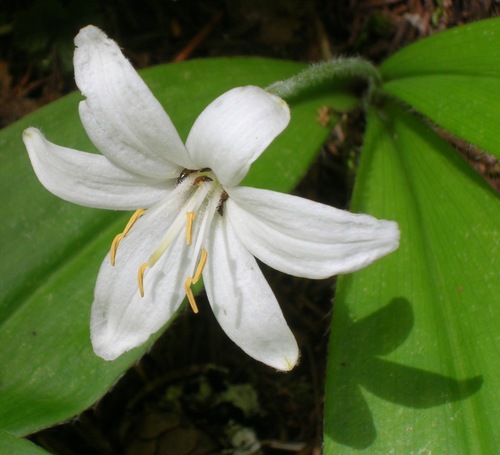
Clintonia uniflora (Menzies ex Schult. & Schult.f.) Kunth is a perennial herbaceous plant that spreads via underground rhizomes. It is the smallest species in its genus, growing only 15 to 25 cm (6 to 10 in) tall. It produces two or three leaves at the base of a hairy stem; each leaf measures 2.5 to 6.5 cm (1 to 3 in) wide and 8 to 20 cm (3 to 8 in) long. A plant usually bears a single flower, though it occasionally produces an inflorescence with two flowers. The small flower has six white tepals, each around 2 cm (0.8 in) long, plus six protruding white stamens with pollen-covered anthers. After pollination, the flower develops into a round blue berry roughly 1 cm (0.4 in) in diameter. This species is native to western North America, ranging from southern Alaska to central California, and extending east into southwestern Alberta and northwestern Montana. It favors cool montane coniferous forests, most commonly growing at elevations between 914 and 1,524 m (3,000 to 5,000 ft). While it occurs in many forest types, it prefers cool, moist coniferous forests dominated by western red cedar (Thuja plicata), western hemlock (Tsuga heterophylla), grand fir (Abies grandis), subalpine fir (Abies lasiocarpa), and Pacific silver fir (Abies amabilis). It is also associated with western white pine (Pinus monticola), Alaska cedar (Chamaecyparis nootkatensis), and noble fir (Abies procera). Common understory companion species include threeleaf foamflower (Tiarella trifoliata), twinflower (Linnaea borealis), and Canadian bunchberry (Cornus canadensis). The range of C. uniflora overlaps with the range of C. andrewsiana in Humboldt County and Del Norte County (northwestern California) and Curry County (southwestern Oregon), but the two species are easily distinguished by their overall size and flowers: C. uniflora has a single flower with white tepals, while C. andrewsiana has multiple flowers arranged in one or more umbels with deep claret red tepals. C. uniflora is a perennial geophyte that can live 30 years or longer. It flowers between late May and July, and fruit matures from late July to September; citizen scientists consistently observe flowering plants throughout June and July. The plant is not considered palatable, but it is at least a minor food source for some wildlife species, including birds, elk, and deer. Frugivorous birds are the only confirmed seed dispersers for this species, and its seeds remain viable in soil for at least a couple of years. Indigenous peoples of the Pacific Northwest, including the Nuxalk, Cowlitz, and Haisla peoples, used the plant as a dermatological aid and eye medicine. The Nlaka'pamux, also called the Thompson people, mashed the ripe blue fruit to use as a dye or stain. Today, C. uniflora is grown as a garden ornamental.