About Clinopodium gracile (Benth.) Kuntze
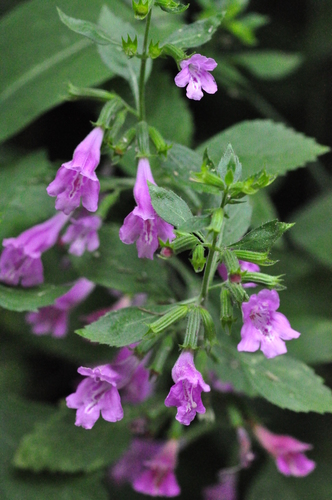
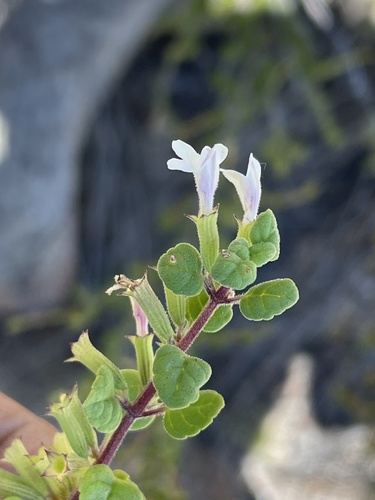
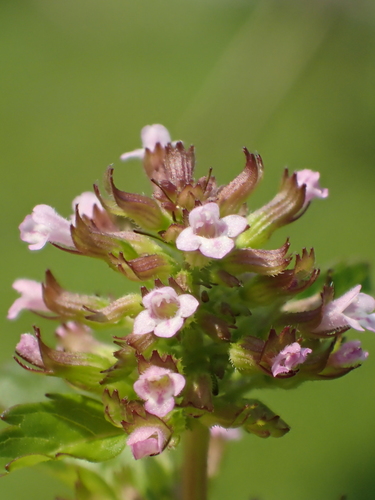
Clinopodium gracile (Benth.) Kuntze is a small, slender, stoloniferous perennial herb. Its stems are quadrangular, numerous, and tufted; they grow 8 to 30 cm tall, are erect or procumbent at the base and ascending, and covered in retrorse pubescence. Leaves are arranged oppositely. Basal leaves are circular-ovate, measuring 1.2–1.5 cm long by 1–1.1 cm wide, with a rounded base, obtuse apex, and remotely crenate margins. Lower and mid stem leaves are ovate, measuring 1.5–2.5 cm long by 1–1.5 cm wide; they are papery in texture, mostly sub-glabrous, with sparse hispid hairs on the veins of their abaxial surface, an obtuse apex, a base that ranges from rounded to cuneate, and margins that are remotely dentate or crenate-serrate. Petioles of stem leaves are 0.3–1 cm long. Inflorescences are verticillasters that hold 5 to 10 flowers each; the verticillasters are either lax or dense, and are crowded into a short terminal raceme. Floral leaves are ovate-lanceolate, measuring 0.5–1 cm long by 0.3–0.8 cm wide, with serrate margins and an acute apex. Bracts are linear, acute, and puberulous, and are much shorter than the pedicels. Flowers are rose-pink, measuring 5–7 mm long by 3–4 mm wide, on 1–3 mm long pedicels. The calyx is tubular with a rounded base, about 3–5 mm long; it curves downward when bearing fruit, and may be puberulent or subglabrous, with minutely hispid veins, sparse fine pilose hairs in the throat, and ciliate hairs on the teeth. The lower two calyx teeth are subulate, while the upper three are triangular; all upper teeth are reflexed when the plant fruits. The corolla is about 4.5 mm long and puberulent. Nutlets are ovoid, smooth, and 0.4–0.5 mm long. This species flowers from June to August, and fruits from August to October. Clinopodium gracile is native to Asia, where it occurs in China, Indonesia, Japan, Java, Korea, Laos, Malaysia, Myanmar, Taiwan, Thailand, Vietnam, and India (specifically the states of Arunachal Pradesh, Assam, Manipur, Meghalaya, Mizoram, Nagaland, Sikkim, and Tripura). It has also been introduced to parts of the Southeastern United States. It most commonly grows near river banks, in wild or semi-wild areas, and along forest margins.