About Clianthus puniceus (G.Don) Sol. ex Lindl.
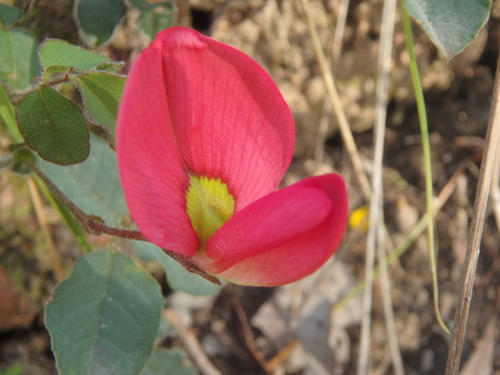
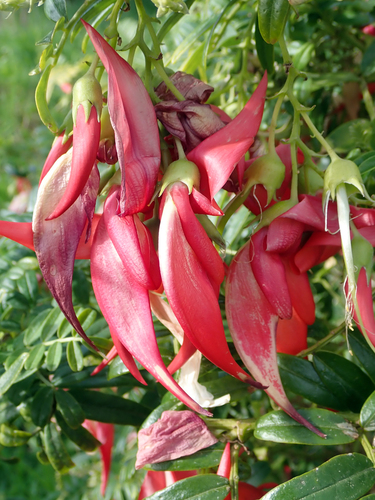
Clianthus puniceus (G.Don) Sol. ex Lindl. is an evergreen shrub, one of two species in the Clianthus genus. Both species have striking clusters of red, tubular flowers that resemble the beak of the kākā, a New Zealand parrot, which gives the plant its common names: parrot's beak, parrot's bill and lobster claw. There is also a variety that produces white to creamy-coloured flowers. Besides its striking red flowers, this species' foliage is often featured on tourist souvenirs and is considered a representative example of New Zealand flora. The species can grow up to 3 meters tall, but generally reaches around 2 m (6 ft 7 in) with spreading branches. It produces leaf stalks up to 15 cm (6 in) long, which hold 10–15 pairs of oblong leaflets. It is not to be confused with C. maximus, which has glossy leaves; the leaves of C. puniceus are matte, because its cuticle has a dense reticulum of buttressed ridges on the adaxial surface. It has pinnate leaves, and flowers arranged in racemes 6–8 cm long. Its flowers have one upright petal, two lateral wing petals, and a downward-pointing keel petal. Wild populations of Clianthus puniceus are rare, and only contain a small number of individual plants. Wild populations grow on cliffs, bluffs, or at the margins of bodies of water. The Latin specific epithet puniceus refers to the reddish-purple colour of the species' flowers. Clianthus puniceus produces perfect flowers with a superior ovary and 10 stamens. It typically flowers from spring through to early summer, but can flower twice a year or even year-round, and the volume of flowering varies annually. A cuticle covers the species' stigma from early bud stage until the flower opens for protection, and inhibits pollination while the cuticle remains intact. Pollination can only happen once the cuticle ruptures, which naturally occurs at flower senescence, though rupture frequently happens before senescence. The cuticle benefits the plant by protecting against self-pollination and increasing the chance of cross-pollination. However, even with this cross-pollination system, the species' observed small gene pool indicates that self-pollination occurs most often and is prevalent. This inbreeding can lead to issues with localized genetic bottlenecks, especially as it occurs in already small populations. When self-pollination takes place, the anthers dehisce, and pollen naturally moves toward the stigma located at the top of the keel. This gravitational movement is caused by the pendulous structure of the flower. C. puniceus is mainly pollinated by birds. While its flowers do not produce much scent to attract pollinators, they contain nectar that attracts many birds, including tūī, korimako, and kākā. Clianthus puniceus is widely cultivated today, and is notable as one of the first endemic New Zealand plants to be grown in cultivation both in New Zealand and overseas. Due to the plant's striking flowers and growth form, seeds were sent from European gardens in New Zealand to many parts of the world, including California and England. Today, the plant is still cultivated in various parts of Europe. While C. puniceus was previously widely grown as a garden plant across New Zealand, it has generally been replaced by the more robust Clianthus maximus. It is cultivated in the UK, where it has given rise to several cultivars. Both the species and the cultivar 'Roseus' have received the Royal Horticultural Society's Award of Garden Merit, confirmed in 2017.