About Clethra acuminata Michx.
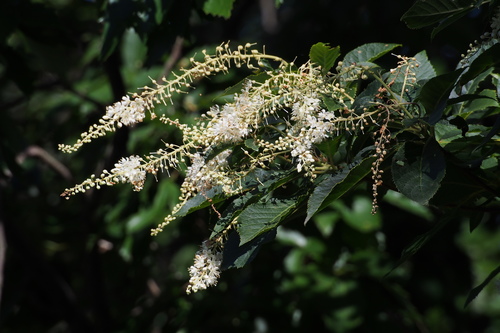
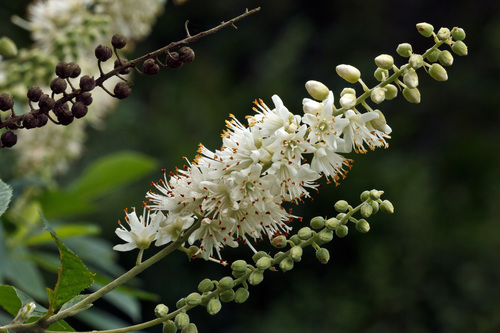
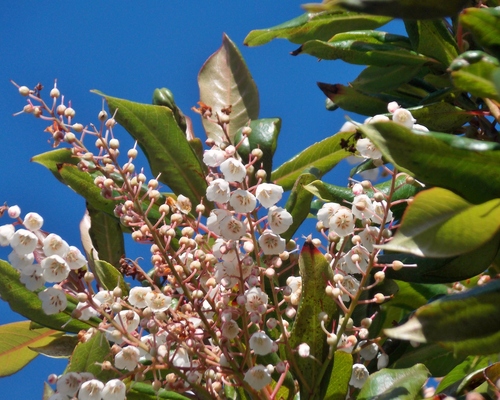
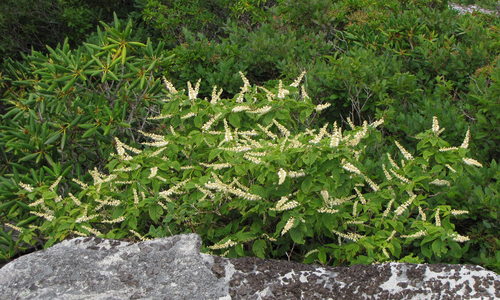
Clethra acuminata Michx. is a dicotyledonous, perennial, temperate deciduous shrub. Mature individuals can reach a height of 6 m (20 ft), with a spread of 4 to 6 feet (8 to 20 feet in total height). It bears simple, alternately arranged leaves that are crowded toward the ends of branches. The leaves are acuminate, 8–20 cm (3.1–7.9 in) long, with fine teeth along the margins. Leaves are glabrous on the upper surface, and either slightly hairy or glabrous on the lower surface. In autumn, the leaves turn yellow and orange. As this species ages, its bark splits and peels in thin sheets to reveal a cinnamon-colored interior; this trait gives the species one of its common names, cinnamon clethra. Its flowers are bisexual, typically white, bell-shaped, and less than one inch long. Flowers are arranged in cone-shaped racemes that are 3–8 inches (7.6–20.3 cm) long, and are rich in nectar. Blooms occur from June to August. After blooming, flowers are lost over winter, and brown capsule fruits form in their place. The fruits, which hold seeds typically eaten by birds, are visible from September to October. Clethra acuminata is commonly mistaken for the related species Clethra alnifolia due to their similar appearance, but they can be distinguished by multiple traits. The most recognizable difference is leaf shape: Clethra acuminata has longer leaves (8–20 cm long) that lack deep serrations, while Clethra alnifolia has shorter leaves (7–10 cm long) with deep serrations along the upper half of the leaf margin. Clethra acuminata also differs from Clethra alnifolia in pubescence during early growth stages, and in the number of vascular suppliers to the sepals. This species is distributed from northwest Georgia to southwest Pennsylvania, where it occurs as an understory plant in high elevation hardwood forests of the Appalachian Mountains. It is adapted to USDA hardiness zones 6a, 6b, 7a, and 7b. Its sister species Clethra alnifolia grows along the Atlantic and Gulf coasts from New York south to Texas, and west as far as Tennessee. Outside its native range, the main modern use of Clethra acuminata is as an ornamental planted in landscapes. The Cherokee people historically used its bark as an antiemetic to ease vomiting, and also as an emetic to induce vomiting. In cultivation, Clethra acuminata grows best in partial sun, in moist, humus-rich, rocky acidic soil with a pH below 6. It does not require seed pretreatment for germination. It responds well to pruning and holds its shape well. It is an important pollinator plant for native plant gardens, supporting and attracting hummingbirds, butterflies, and honeybees. It is generally hardy against common pests including deer, most diseases, and other physiological issues, with no widespread common pest problems; however, root rot is a common issue. When grown successfully in cultivation, it can reach over twenty feet tall.