About Clerodendrum trichotomum Thunb.
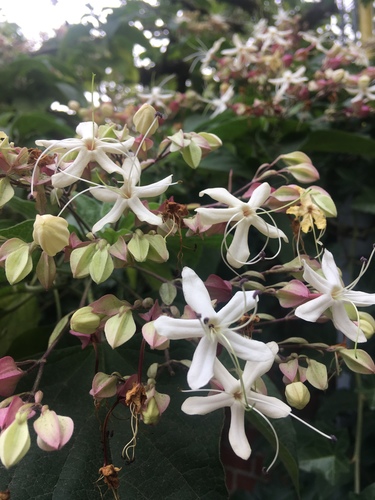
Clerodendrum trichotomum Thunb. has dark green, ovate leaves that grow up to 12 cm (5 inches) long. The leaves are soft and downy or hairy, and give off a peanut butter scent when crushed; some varieties have toothed leaves. This species is deciduous, and its leaves do not change color in autumn, staying green until they drop after the first seasonal frost. Its fragrant flowers grow on branching peduncles. Each flower has five white petals, held within a green calyx that turns red as the fruits ripen. This plant cannot self-pollinate, so at least two individuals are required to produce fruit. Fruits are drupes that start out white, change to bright blue, and finally become dark blue when fully mature. Flowers bloom in late summer and early autumn, and ripe berries can stay on the plant well into winter; flowers and mature fruits can grow at the same time on the same plant. Its bark is brownish-grey, with a smooth or lightly fissured texture, and has many lenticels. This plant produces constant basal shoots, and reaches a mature height of 3–6 metres (10–20 ft). It can be trained and shaped to grow as a shrub, or it can grow into a tree if left untrimmed to grow tall, it does not die back over winter, and excess shoots are trimmed. It is moderately drought tolerant, one of the hardiest species in its genus, and grows in USDA zones 7 through 10. It can grow in full sun or partial shade, but blooms best in full sun. It prefers growing near protective structures such as walls; mulching in winter is often recommended for plants grown in exposed gardens. It grows best in fertile, moist, well-drained soil, but also tolerates acidic, loamy, sandy, or clay soils. It is reported to be easy to transplant, and regrows well from roots. According to the JC Raulston Arboretum, it can be propagated from seed or from cuttings taken from partially hardened wood in early summer, rooted under mist. Common pests affecting Clerodendrum trichotomum are whiteflies, mealybugs, and aphids. This plant is grown as an ornamental, especially in non-native regions of Europe and the Americas, and is particularly popular in the Southeastern United States. Some sources classify the species as invasive in the US, while others note it is only naturalized here. It is often trimmed into hedges for privacy screening. It attracts moths, butterflies, bees, and hummingbirds, and is often used in butterfly gardens. In its native range across parts of East Asia, its leaves are sometimes eaten as a foraged wild vegetable; they are boiled to remove their characteristic odor. Its wood is used to make clogs. In some Japanese villages, a type of grub that lives in the plant's trunk is toasted and fed to children to calm them. The berries contain the novel pigment trichotomine, and can be used to make natural dyes.