About Clerodendrum tomentosum (Vent.) R.Br.
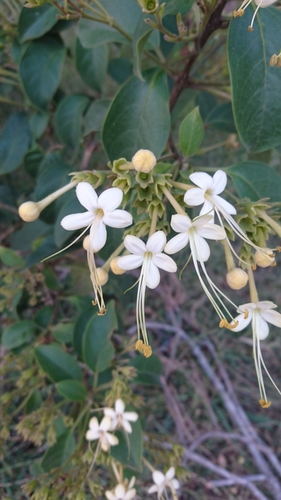
Clerodendrum tomentosum (Vent.) R.Br. typically grows much smaller than its maximum size of 15 metres tall, with a maximum trunk diameter of 25 centimetres. It is an open-branched plant with large veiny leaves. Its trunk is mostly cylindrical, and sometimes flanged at the base. On larger plants, the bark is grey or fawn, and somewhat scaly or corky. Young branchlets have lenticels, are downy and soft, are angled or square in cross-section, brownish grey, and sometimes purple at the tips. Leaves grow opposite on the stem, have no serrations, and measure 4 to 14 cm long and 2 to 4.5 cm wide. Leaves have a short tip, and gradually taper towards the base. The upper leaf surface is sometimes hairy, while the undersurface is hairy, soft, and downy to the touch. Leaves are darker green on the upper surface and pale green on the undersurface. Leaf veins are prominent on the underside and visible on the top surface, with 5 or 6 main lateral veins that curve near the leaf edge. White fragrant flowers grow in dense heads from October to January; they form cymes arranged in terminal corymbs, and four long stamens protrude from each flower. Flowers are pollinated by nocturnal moths. The fruit is a black shiny or navy blue four-lobed drupe, 5 to 8 mm across, surrounded by a fleshy red calyx that can reach up to 20 mm wide. The contrasting red calyx and black drupe attract birds, including the satin bowerbird. This fruit is not edible for humans. Clerodendrum tomentosum regenerates slowly from seed, but can be propagated successfully from cuttings. For Australian native gardens, this species is suitable for planting due to its attractive flowers and fruit. It attracts birds and butterflies, and is also used as a pioneer species in ecological regeneration areas.