About Clerodendrum infortunatum L.
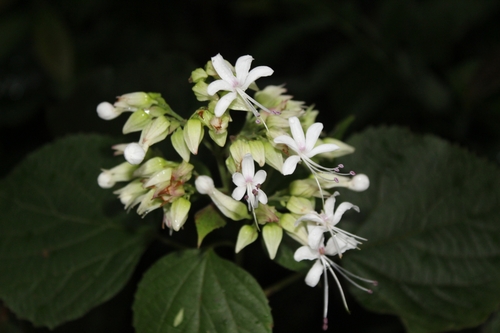
Clerodendrum infortunatum L. is a flowering shrub or small tree that gets its scientific name from its rather unattractive leaves. Its erect stem is unbranched, 0.5 to 4 meters (1.6 to 13.1 feet) high, and hollow. There are conflicting recorded leaf arrangements in this description: one source notes leaves are simple and opposite, while another states they are borne in whorls of four on very short petioles. Leaf dimensions also vary across records: one source mentions circular leaves 15 centimeters (5.9 inches) in diameter, another notes leaves 15 to 20 centimeters (5.9 to 7.9 inches) long. Leaf shapes recorded include elliptic, broadly elliptic, ovate, or elongate ovate, 3.5–20 cm (1.4–7.9 in) wide and 6–25 cm (2.4–9.8 in) long. Leaves have dentate margins, and both leaf surfaces are sparsely villous-pubescent. Inflorescence records also differ: one describes it as a terminal, peduncled, few-flowered cyme, while another notes it is a large terminal cluster up to 0.6 meters (2 feet) long made up of many flowers. Flowers are typically white with a purplish pink or dull-purple, pubescent throat; the large inflorescence variant has drooping tubular flowers around 10 cm (3.9 inches) long, with expanded corollas around 5 cm (2.0 inches) across. The fruit is a globose berry (also described as an attractive dark metallic blue drupe) that turns bluish-black or black when ripe, enclosed in a red accrescent fruiting calyx, and is around 1 cm (0.4 in) in diameter. The fruit usually contains four dry nutlets, and seeds may or may not have endosperm. This species flowers from April to August. Clerodendrum infortunatum is used in Ayurvedic and Siddha traditional herbal medicine. Fresh leaves are used to treat diarrhea, liver disorders, and headache. Leaves and roots are used for their antidandruff, antipyretic, ascaricide, laxative, vermifuge, anticonvulsant, and antidiabetic properties, and to treat gravel, malaria, scabies, skin diseases, sores, spasm, scorpion stings, snake bites, and tumors. Leaves and roots are widely used as an antihyperglycemic in many traditional practices.