About Clepsis persicana (Fitch, 1856)
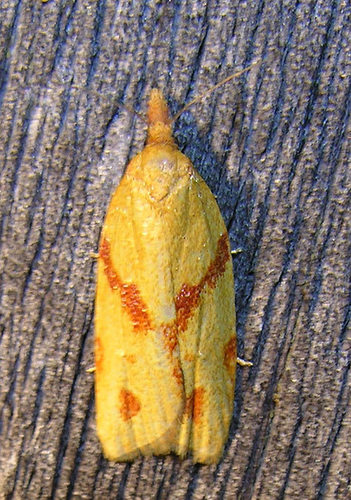
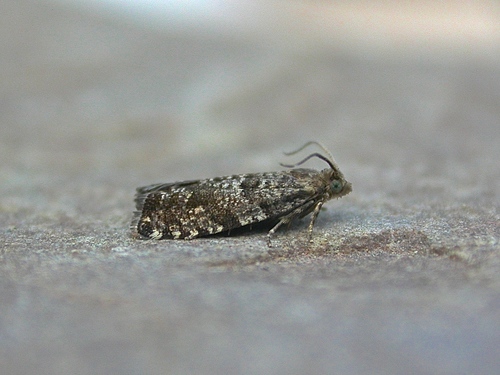
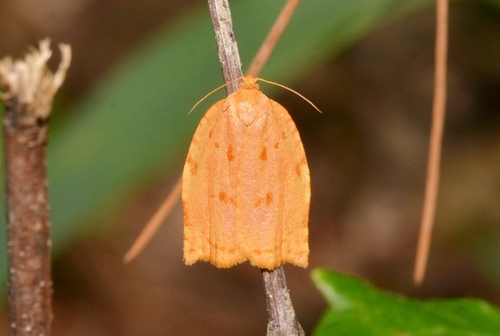
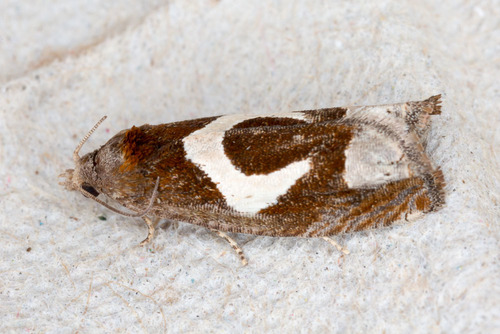
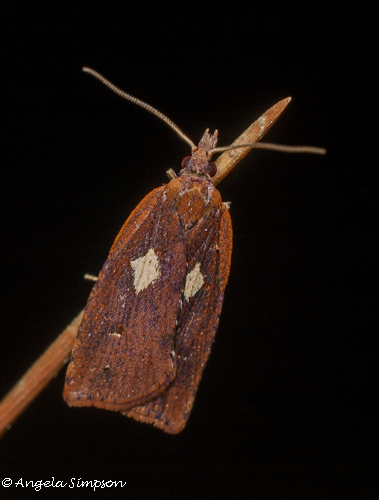
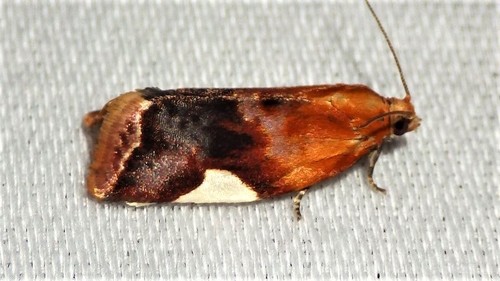
Clepsis persicana, commonly known as the white triangle tortrix or the green needleworm, is a species of moth in the family Tortricidae. It is native to North America, with recorded ranges extending from Alaska and British Columbia east to Newfoundland, south to Virginia, and west to California. Its habitat includes coniferous and mixed coniferous forests. Adult males have forewings measuring 8.5–10.5 mm long, while adult females have forewings 10–11 mm long. The forewings are orange near the base, darkening to a purplish shade towards the pale-edged termen. Adults fly from June to August, producing one generation per year. The species overwinters as a mid-instar larva. Pupation occurs either under the bark of the larva's host plant or among fallen leaves at the base of a tree. Mature larvae are slender, very active, with yellow heads and wide, indistinct greyish stripes on their bodies. They have also been described as having yellowish-green or greyish-green bodies with yellowish-brown heads. Larvae can be found from April to June; in Ontario, larvae have been collected specifically in late May and June. Young larvae lower themselves on silk threads to search for abandoned shelters made by other Tortricidae species; if no abandoned shelter is found, they will feed on low cover plants growing on the ground. Larvae feed on a wide variety of both deciduous and coniferous trees, including species from the genera Acer (including Acer negundo), Osmorhiza, Solidago, Alnus (including Alnus viridis, Alnus incana), Betula (Betula papyrifera, Betula nana), Corylus, Cornus canadensis, Rhododendron canadense, Vaccinium, Frasera (including Frasera fastigiata), Ribes, Maianthemum canadense, Comptonia peregrina, Fraxinus, Abies (including Abies balsamea, Abies concolor, Abies lasiocarpa), Larix (Larix occidentalis), Picea (including Picea glauca, Picea engelmannii), Pinus (including Pinus banksiana), Pseudotsuga (including Pseudotsuga menziesii), Ceanothus, Malus pumila, Prunus (including Prunus virginiana, Prunus persica), Rosa, Rubus, Populus (including Populus tremuloides, Populus balsamifera), Salix and Ulmus. Larvae create webs on the leaves of their host plant and feed within the calyx. No control measures are currently needed for green needleworms.