About Cleora cinctaria (Denis & Schiffermüller), 1775
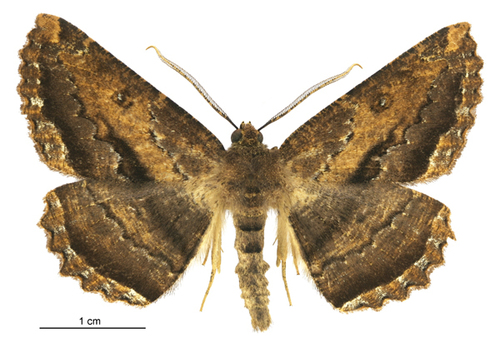
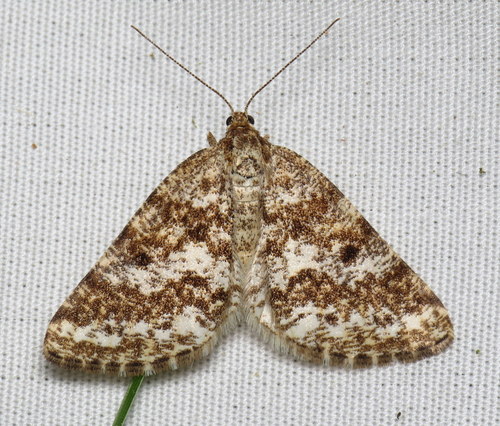
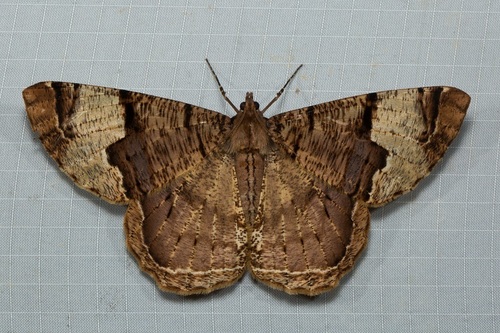
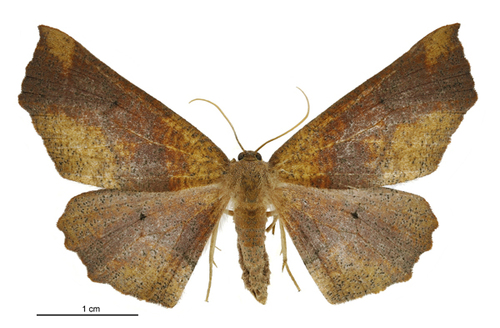
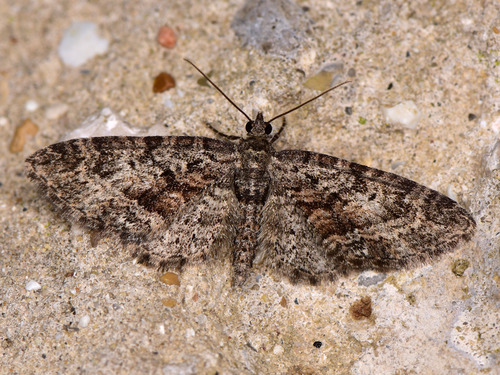
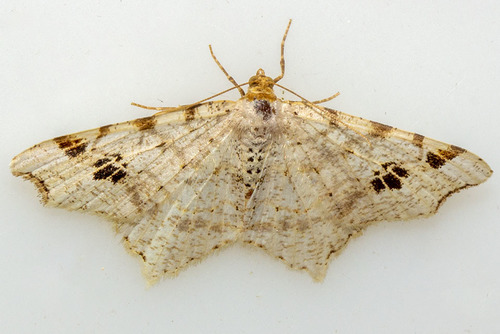
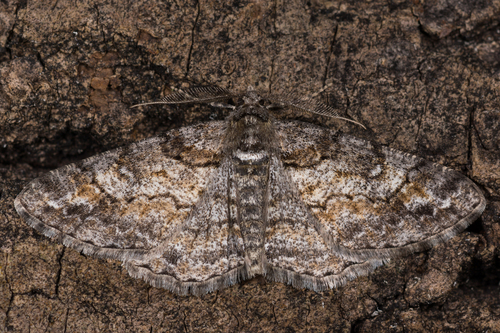
Cleora cinctaria, commonly known as the ringed carpet, is a moth species belonging to the family Geometridae. It was first formally described by Michael Denis and Ignaz Schiffermüller in 1775. This species is distributed from Europe through southern Siberia, Turkey, the Caucasus, central Asia, Mongolia, and also occurs in Japan. The wingspan of adult ringed carpet moths ranges from 28 to 35 mm. Their wings have a light grey base colour, with brown marking lines. The intensity of both grey and brown colouration varies considerably between individuals. The interior crossline is shaped like a band and wider towards the base of the wing, while the exterior crossline curves toward the front wing edge and is typically double. The darkened brownish wing margin has a white wavy line and white dusting. Hindwings feature dark lines and an often indistinct whitish squiggle marking. The first abdominal segment forms a distinct white belt. Male antennae are bipectinate (combed on both sides), while female antennae are filiform. Prout has documented accounts of this species' named forms. Fully grown larvae are smooth and light green, marked with bluish-green and white longitudinal lines. Adult moths are active on the wing from April to May. Larvae feed on a wide variety of plants and trees, including Betula (specifically Betula verrucosa), Myrica gale, Carex, Salix, Populus tremula, Rubus idaeus, Sorbus aucuparia, Vicia cracca, Rhamnus frangula, Lysimachia vulgaris, Vaccinium myrtillus and Galium verum.