About Cleomella serrulata (Pursh) Roalson & J.C.Hall
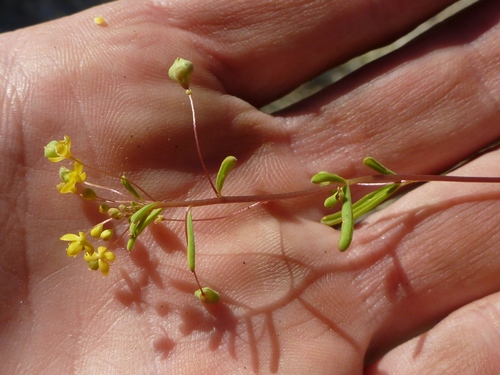
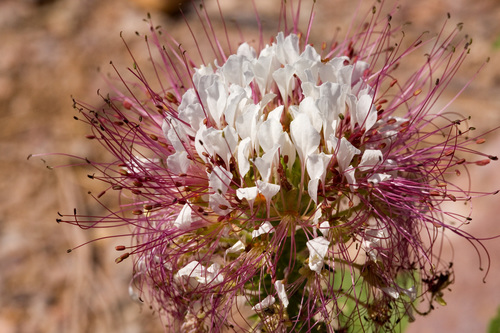
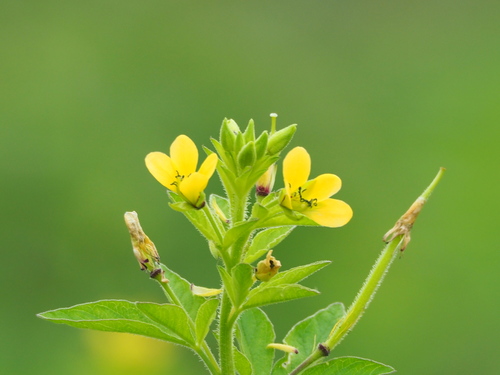
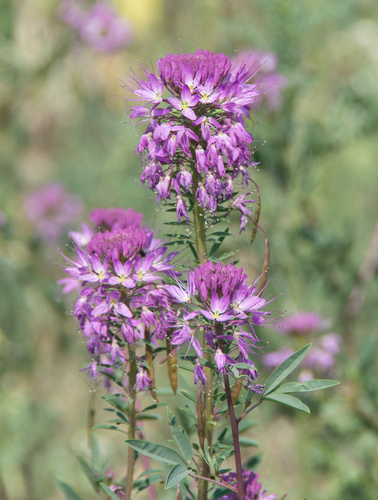
Cleomella serrulata (Pursh) Roalson & J.C.Hall is an annual plant that reaches 10–150 cm (4–59 in) in height, with spirally arranged leaves. Its leaves are trifoliate, bearing small teeth, and have three slender leaflets that each measure 1–7 cm (0.5–3 in) long. The flowers come in reddish-purple, pink, or white, with four petals and six long stamens. Its fruit is a 3–6 cm (1–2.5 in) long capsule that holds several seeds. Flowering occurs over an extended period because it starts at the bottom of the stalk and progresses upward, and flowering and the development of seed pods begin at the same time. Specimens growing in drier climates have higher cell wall elasticity. This species' pollen is around 0.015 millimeters (0.00059 in) long, with three furrows that each contain one pore. Moisture, temperature, and time are critical for seed germination; germination takes place in summer, and plants can grow quickly to 1–2 meters (3.3–6.6 ft). A wide range of insects, especially bees, are often found on the flowers. The elongated capsules hold dark brown to black, curved seeds with a wart-like texture. After seeds are dispersed, the plants begin to decompose. The plant is called waaʼ in the Navajo language, tumi in the Hopi language, and both aʼpilalu and ado꞉we in the Zuni language. Cleomella serrulata is native to southern Canada from British Columbia to Ontario, and to the United States from the west coast east to Ohio and southwest to Texas. It is also naturalized further east in North America, including in Maine. This species is often found on disturbed land, such as roadsides, open woods, mountain foothills, and prairies. It prefers moist alkaline light or sandy soils, tolerates a wide range of pH levels, and grows well in mild shade or full sun. It is also drought tolerant. In the northern Rocky Mountains, it is commonly found at elevations between 760–2,200 metres (2,490–7,220 ft). It often grows alongside Pascopyrum smithii (western wheatgrass), Pseudoroegneria spicata (bluebunch wheatgrass), Koeleria macrantha (prairie Junegrass), Poa secunda (Sandberg bluegrass), Gaillardia aristata (common gaillardia), Artemisia tridentata (big sagebrush), and Ratibida columnifera (prairie coneflower). The flowers of Cleomella serrulata attract and support a wide variety of pollinators, and it is a larval host plant for the checkered white butterfly. Cleomella serrulata has been used as food, medicine, and dye by peoples in the southwestern United States since prehistoric times, and is one of the few wild foods still in use today. As food, its seeds can be eaten raw or cooked, or dried and ground into meal to make mush. Tender leaves, flowers, and shoots can be cooked and eaten as a cooked vegetable, or added to cornmeal porridge. The Zuni people gather large quantities of the leaves, hang them indoors to dry for winter use, and cook young leaves with corn heavily flavored with chili peppers. To reduce the plant's bitter taste, pieces of iron or rust were sometimes added to the cooking pot. Animals rarely feed on this plant due to its unpleasant taste and odor, and consuming too much can cause nitrate poisoning. Birds eat the plant's seeds, and it provides good cover for land reclamation and upland birds. The Tewa and other Southwestern United States tribes often included Cleomella serrulata as a "fourth sister" in the Three Sisters agricultural system, because it attracts bees to help pollinate beans and squash. In traditional Native American and frontier medicine, an infusion of the plant is used to treat stomach troubles and fevers, and poultices made from the plant can be applied to the eyes. As a dye, the plant can be boiled down until it forms a thick, black syrup. Ancestral Puebloans used this as a binder in pigments for painting black-on-white pottery as early as 900-1300 CE. The Navajo still use the plant to make yellow-green dye for their rugs and blankets. Plant paste is mixed with black mineral paint to color plume offering sticks for anthropic gods, and the whole plant except the root is used for pottery decoration.