About Cleomella arborea (Nutt.) Roalson & J.C.Hall
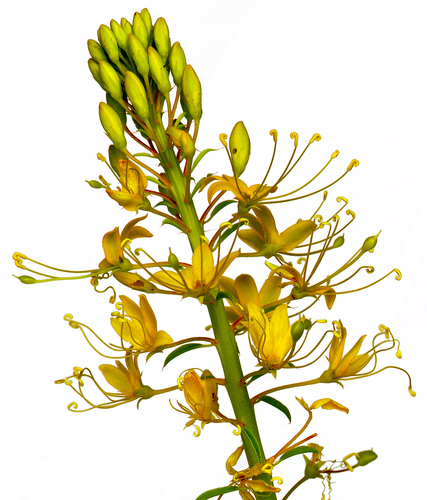
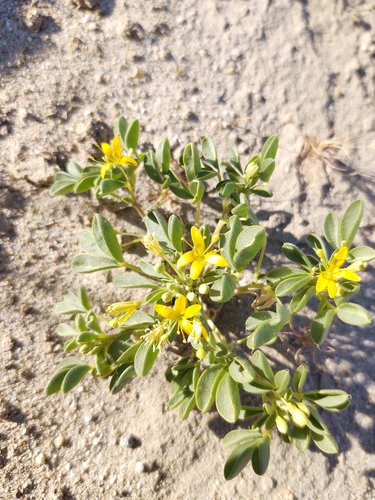
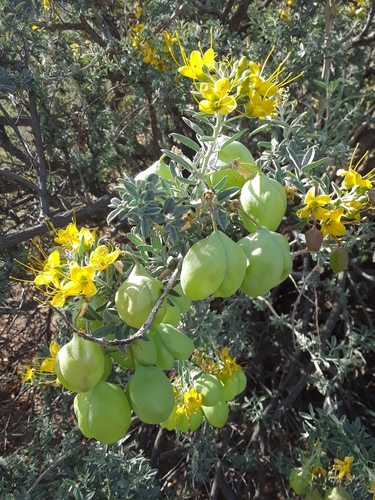
Cleomella arborea (Nutt.) Roalson & J.C.Hall is a densely branching shrub that grows 0.5 to 2 metres (1 ft 8 in to 6 ft 7 in) tall, and its entire surface is covered in tiny hairs. Its stalked leaves typically consist of three equal leaflets, each 15 to 45 millimetres (0.6 to 1.8 in) long, oval to elliptic in shape, with pointed tips. This plant produces abundant inflorescences at the ends of stem branches for most of the year. Its four sepals are fused from their base for roughly half their length. Each flower has four bright yellow petals 8 to 14 millimetres (0.3 to 0.6 in) long, plus six protruding stamens 15 to 25 millimetres (0.6 to 1.0 in) long, with anthers 2 to 2.5 millimetres (0.1 to 0.1 in) in size. The style measures 0.9 to 1.2 millimetres (0.04 to 0.05 in), or it may abort before the flower opens. The fruit is a leathery prolate spheroid capsule that is 30 to 60 millimetres (1.2 to 2.4 in) long, 10 to 25 millimetres (0.4 to 1.0 in) wide, and borne on a 10 to 20 millimetres (0.4 to 0.8 in) stalk. The fruit is smooth and green when young, and fades to light brown as it ages. On a typical inflorescence, multiple flower buds sit at the tip, open flowers grow just below the buds, and maturing fruits (from flowers that have already shed their parts) develop below the open flowers. The former genus name Isomeris comes from the roots "iso" meaning "equal" and "meris" meaning "part", a reference to the plant's stamens being of equal length. Cleomella arborea grows natively in California and the Baja California Peninsula, ranging from the western Mojave Desert and Colorado Desert to the Baja California Peninsula. It is most commonly found along roadsides, in desert dry washes, and on flat areas, at elevations up to 4,200 feet (1,300 m). It grows in a range of habitat types, most often desert or brush habitats. It blooms throughout the year, and acts as a nectar source for pollinators including bees and butterflies. This plant is adapted to arid environments, and tolerates dry soil and dry growing conditions.