About Cleomaceae
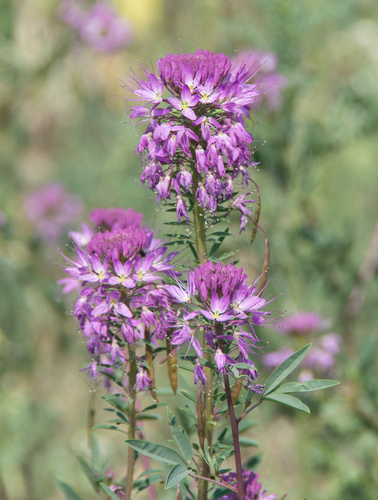
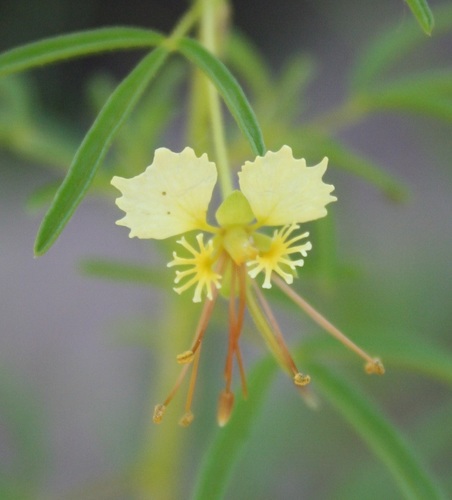
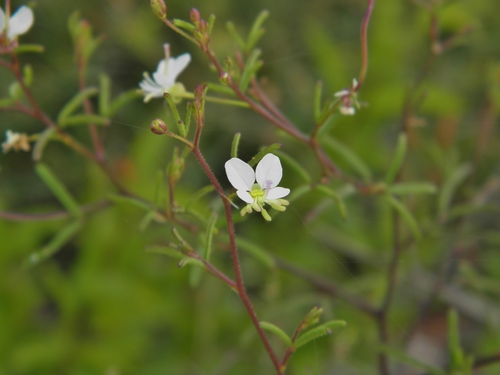
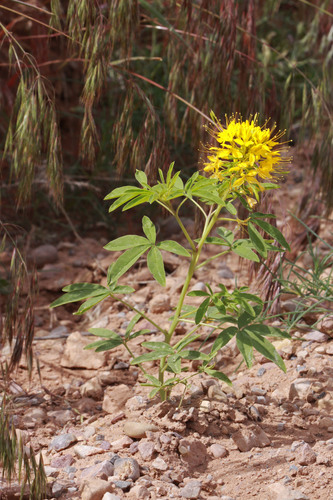
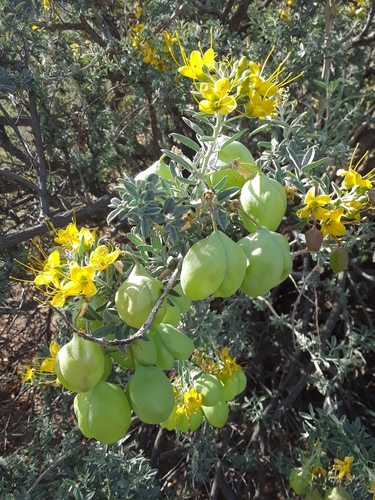
Cleomaceae are mostly annual herbaceous plants, sometimes perennial herbaceous plants, and are seldom found as shrubs or small trees, with some species growing as lianas. Most members of the family have glands, a trait that distinguishes them from the related Capparaceae. Cleomaceae also contain resins, and may have an aromatic or unpleasant foetid smell. Their leaves are arranged alternately, have leaf stalks, and never form a sheath around the stem. All Cleomaceae leaves are palmately compound, most often with three to seven leaflets, and only rarely with just one leaflet. At the base of the leaf stalk are scaly, leafy, or spiny stipules. This distinguishes Cleomaceae from its sister group Brassicaceae, which consistently lack stipules, although Brassicaceae may sometimes have a pair of glands at the base of the leaf stalk. Hairs and papillae may be present on Cleomaceae plants. The flowers of Cleomaceae are somewhat to strongly bilaterally symmetric. Sepals are mostly four in number, sometimes two or six, and may be free or merged; they may be shed quickly after opening or remain on the flower, and are either overlapping in the bud or already separate in the bud. The corolla is mostly made up of four petals, sometimes two or six petals, which have distinct claws and limbs, and can have free or merged limbs. The stamens may be positioned at the same level where the perianth inserts, or they may be carried on a stalk that lifts the stamen bases above the perianth; this trait can be seen for example in Gynandropsis gynandra. Cleomaceae may have four simple stamens, or branched stamens grouped into four clusters of up to 12 stamens each that share a common base, and all stamens are free from the petals. When stamens are grouped in clusters, anthers mature from the center of the cluster outward. The base of the stamens may or may not be fused with the female reproductive parts in the center of the flower. Filaments may all be the same length or differ strongly in length, and all filaments may bear anthers, but infertile staminodes may also occur. Anthers release their pollen through slits that run along the length of the anther. The ovary is positioned above the perianth and androecium, making it a superior ovary, and is made up of two fully merged carpels. It contains a single cavity, which may be split into two sections by a partition called a replum. Between 10 and 50 ovules, which will develop into future seeds, are arranged along the margins of each carpel. As the fruit ripens, a stalk called a gynophore develops. The dry fruit opens along two valves. If the fruit has a replum, it shares the same basic morphology as Brassicaceae fruits, which are called silicula or siliqua. This trait distinguishes Cleomaceae fruits from those of Capparaceae, which form capsules.