About Clematis paniculata J.F.Gmel.
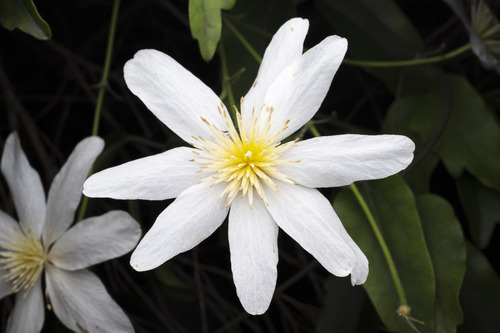
Clematis paniculata J.F.Gmel. is an evergreen, woody, high-climbing vine. Its woody stem typically reaches 10 cm or more in diameter at the base, and it produces stout branchlets. Its leaflets are leathery in texture, with visible pores and wrinkles; overall, leaves are shiny and tough in appearance, dark in colour, broadly ovate to broadly oblong in shape, with a heart-shaped to truncate base. Leaves are sparsely hairy on the lower surface, and leaf margins may be toothed, entire, or lobed near the apex; profound lobing occurs only rarely. This species is dioecious (unisexual), producing separate male and female plants; the male and female flowers are similar in structure. Both flower types have six white sepals, which narrow toward the end, and terminate in either a rectangular or rounded tip. Female flowers have smaller sepals than male flowers: females have few staminodes, while males have many. Female plants produce hairy achenes 2–4 millimetres long, and do not bear persistent fruits. Clematis paniculata is native to New Zealand, and occurs naturally across the North, South, and Stewart Islands; it has also become naturalised on the Chatham Islands. It grows throughout New Zealand in lowland and subalpine habitats, ranging from coastal areas up to elevations between 300 and 800 metres above sea level, where it occurs in tall forest or shrubland. It flowers from August to November, and produces fruit from October to January. Male flowers bear stamens, the male reproductive organs that produce pollen for plant reproduction. Its seeds are held in silky, feather-like clusters, and are easily dispersed by wind. Seed germination occurs within 2–3 months, though germination timing can be erratic. In Te Reo Māori, this species is called Puawananga, and it holds major cultural significance for Māori communities. Many Māori iwi (tribes) recognise Puawananga, alongside Whauwhapaku, as the offspring of Puanga (Rigel), the brightest star in the Orion constellation, and Rehua (Antares), the brightest star in the Scorpio constellation. The morning rising of these two stars signals the approach of summer. The period between the two risings, which falls between June and November, aligns with Puawananga’s flowering season. Māori have used the flowering of Puawananga as an indicator that spring has begun, and that eels have started migrating upriver to spawn—an event that coincides with flowering, marking the appropriate time to harvest eels. Māori women used Puawananga to create decorative pieces for hair wreaths and garlands. There are historical records of Māori ancestors using Puawananga for medical purposes, which was only used by women. It was taken to treat a range of conditions including general blood disorders, skin eruptions, kidney troubles, haemorrhages, and bleeding piles. Leaves were used to produce blisters as a counter-irritant, and sap was applied to help heal wounds. It was taken three times daily before meals.