About Clematis lasiantha Nutt. ex Torr. & A.Gray
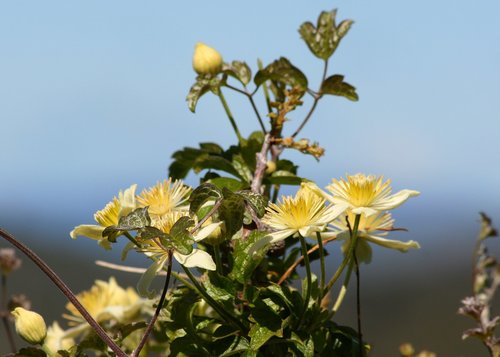
Clematis lasiantha, commonly called pipestem clematis, flowers between January and June. Its leaves are 3-lobed, and typically grow in groups of three to five leaflets. The largest leaves on this plant usually measure between 3 and 5 cm in size. Pipestem clematis can be told apart from the similar, much more widely distributed virgin's bower by several traits. Normally, each stalk of pipestem clematis holds only one flower, with at most three flowers per stalk, while virgin's bower produces multiple flowers per stem. Each flower of pipestem clematis also contains more pistils than a flower of virgin's bower, but this characteristic is not easy to use for identification, as both species have many pistils. Virgin's bower occurs more often along streams or other wet areas, while pipestem clematis tolerates more open, drier growing sites. This plant attracts butterflies. It is distributed along the Pacific coast of North America, ranging south from the San Francisco Bay Area into Baja California. It extends east as far as the western foothills of the Sierra Nevada mountains. It does not grow in the Central Valley, and does not occur at elevations higher than around 2,000 metres (6,600 ft). Its typical growing habitats are hillsides, chaparral, and open woodland.