About Claytonia virginica L.
Claytonia virginica L., commonly called springbeauty, is a perennial plant that overwinters via a tuberous root. It is a trailing species that grows 5–40 cm (2–16 in) tall. Its leaves are slender and lanceolate, measuring 3–14 cm (1+1⁄4–5+1⁄2 in) long and 0.5–2 cm (0.20–0.79 in) broad, with a 6–20 cm (2+1⁄4–7+3⁄4 in) long petiole.
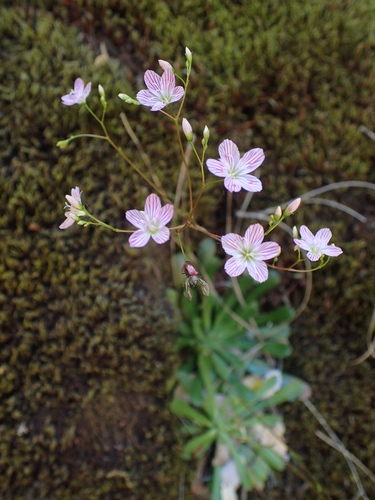
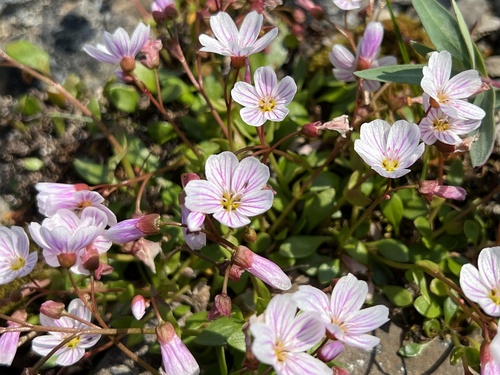
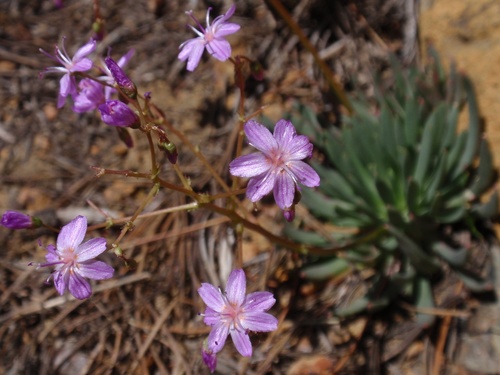
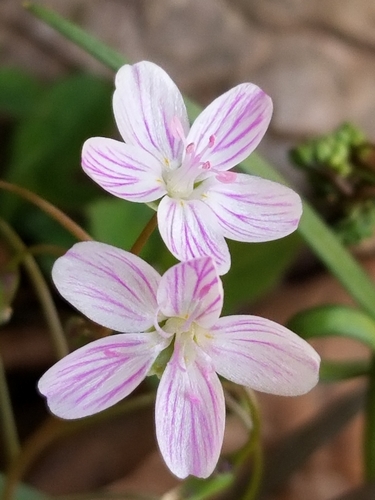
The flowers are 0.7–1.4 cm (0.28–0.55 in) in diameter, with five petals that are usually pale pink or white, and rarely yellow. The flowers reflect UV light, and are arranged in a raceme inflorescence where flowers branch off the main shoot. Individual flowers bloom for three days, but the five stamens on each flower are only active for one day. Flowering occurs between March and May, depending on the plant's location and local weather. Seeds are 0.2 to 0.3 cm (0.08 to 0.12 in) in diameter, shiny black, and released when the capsule fruit splits open. The seeds have elaiosomes, which facilitate dispersal by ants.
Claytonia virginica is a cytologically complex taxon. It includes diploids with n=6, 7, 8 and 9, as well as tetraploids, hexaploids, octaploids, and dodecaploids. The highest observed chromosome number (2n=ca. 191) was recorded in the New York area.
Springbeauty occurs in the Eastern temperate deciduous forest of North America, and is abundant across much of its range, especially in forested areas. It grows in a wide variety of habitat types, including lawns, city parks, forests, roadsides, wetlands, bluffs, and ravines.
This plant has been used medicinally by the Iroquois, who gave a cold infusion or decoction of powdered roots to children with convulsions. The Iroquois also ate raw roots in the belief that this permanently prevented conception. Both the Iroquois and Algonquin people ate the plant's roots; the Algonquin cooked the roots like potatoes. The bulbs are high in starch. Cooked roots are described as tasting similar to chestnuts, while raw roots are said to taste like radishes. The roots are rich in vitamins A and C. Springbeauty corms and the entire above-ground portion of the plant are safe for human consumption. Leaves can be cooked in salted water or steamed, though they are not considered a particularly desirable food.