About Claytonia caroliniana Michx.
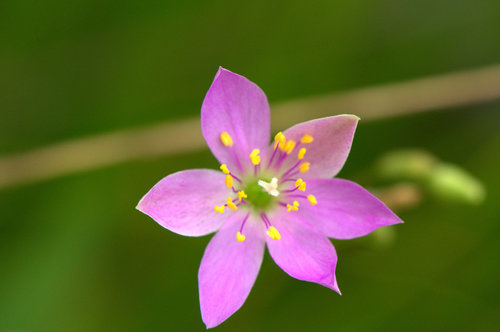
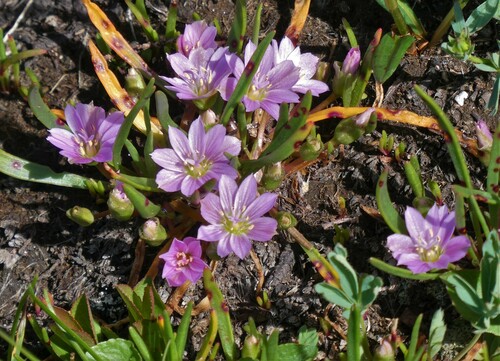
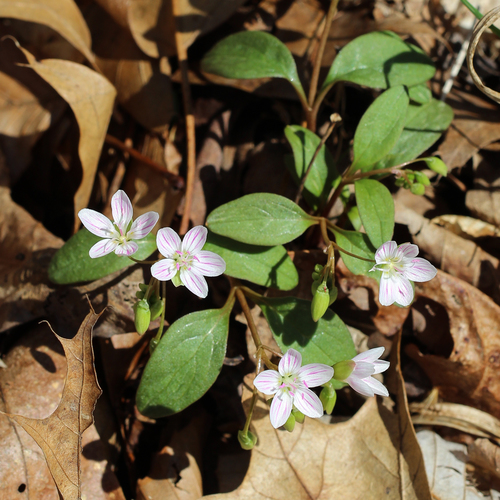
Claytonia caroliniana Michx. is a flowering, woodland perennial herb. It grows from March through June and is one of the earliest spring ephemerals. It grows from spherical underground tubers in light humus, and sprouts and blooms before the tree canopy develops. Once the growing area becomes shaded, the aboveground portions of the plant wither, leaving only the tuberous roots underground. Its flowers have five pink and purple petals, with dark pink veins that accent the petals and give them a striped appearance. The carpels are fused together. The plant grows on a stem 3 to 10 inches tall that bears a single pair of broad leaves. There are two leaves that grow opposite each other at one node; these leaves have no teeth or lobes, have a prominent central vein, and grow up to three inches long and 1/2 to 3/4 inches wide. This broad-leafed trait distinguishes it from the similar species Claytonia virginica, which has longer and much narrower leaves. While it is similar to some Arctic claytonias, it is probably most closely allied to Claytonia ozarkensis. Natural hybrids between Claytonia caroliniana and Claytonia virginica have been documented. This plant is edible, but its practical usability is limited because it is difficult to harvest, and each individual plant only produces a small quantity of usable material. Its tuberous roots are edible, rich in starch, and can be eaten cooked or raw. The leaves are also edible. The tuberous roots are eaten by eastern chipmunks and white-footed mice.