About Clausena anisata (Willd.) Hook.fil.
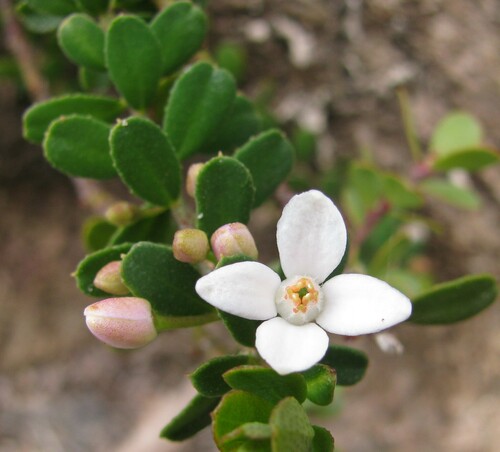
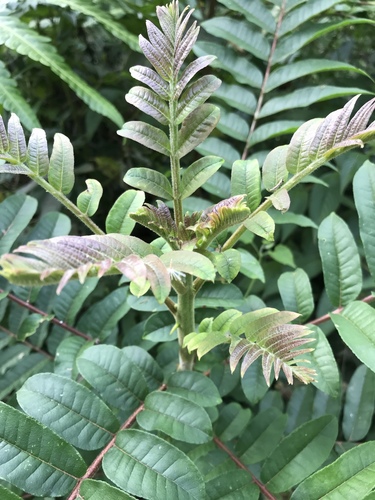
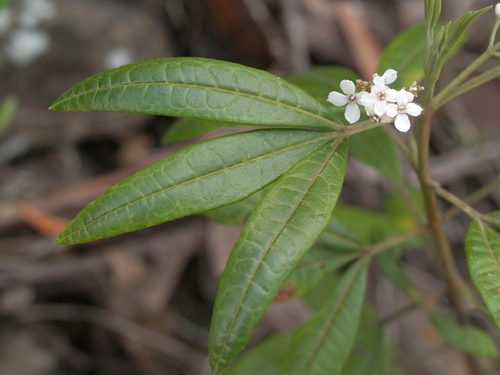
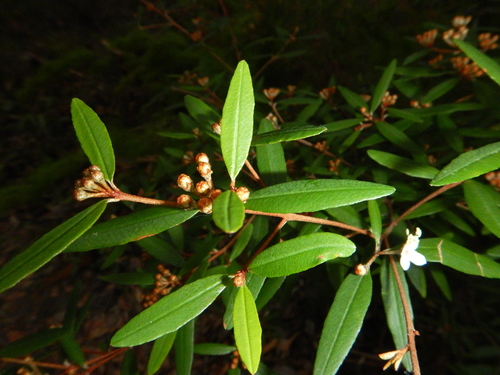
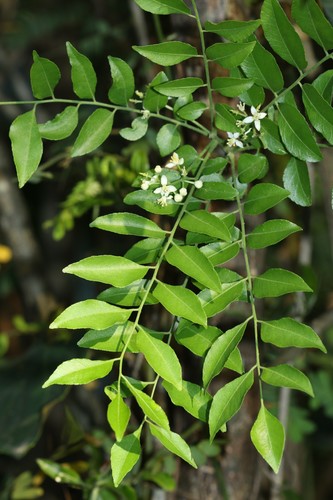
Clausena anisata (Willd.) Hook.fil. is a plant that grows up to 10 m tall. It has smooth, thin, grey-green bark that becomes brownish and mottled as the plant ages. Young parts of the plant are puberulous. Its compound leaves grow up to 30 cm long, and stipules are absent. There are 11–37 leaflets, which are arranged alternate to sub-opposite, shaped ovate to narrowly elliptical, with a markedly asymmetric base that is either rounded or cuneate. The leaflet apex is obtuse or notched, and the margins are entire or crenulate. Leaf surfaces are densely covered with embedded, pellucid glands that give off a strong aroma when bruised. The inflorescence is a hairy, lax axillary panicle. Flowers are scented, bisexual, regular, and 4-merous. Sepals are roughly 1 mm long, while elliptical petals are 3–7 mm long, concave, and coloured cream to yellowish-white. The 8 stamens have filaments 2–6 mm long that are thickened at the base. The fruit is an ovoid, fleshy berry 3.3–7 mm in diameter, single-seeded, and turns red or purplish-black when mature. The timber is yellowish-white, elastic, and dense with a weight of 0.8 g/cm³. This species is used to treat a very wide range of ailments and conditions. Decoctions made from the leaves or roots are taken to treat gastro-intestinal disorders, fever, pneumonia, headache, hypotension, sore throat and sinusitis, and venereal diseases; it is also used as an aphrodisiac, an anthelmintic, a tonic for pregnant women, and a tonic for infants to prevent rickets and control convulsions. Root decoctions and infusions are also taken for whooping cough, malaria, syphilis, kidney ailments, irregular menses, threatening abortion, skin diseases, and epilepsy, and are given to women before and after childbirth to ease delivery, expel blood from the uterus, and later boost milk production. Roots are chewed to relieve indigestion. Crushed leaves are used as an antiseptic and analgesic, applied to open wounds, mouth infections, otitis, abscesses, burns, haemorrhoids, rheumatism, and general body pains. Crushed leaves are also used to treat wounds in domestic animals, and as an antidote for snake bites. Dried leaves are widely used as an arthropod repellent, for example as filling for mattresses and pillows to repel fleas, lice, and bedbugs. The sweet fruits are eaten readily by people and other animals. Pounded stem bark is used to make rope.