About Clathrus ruber P.Micheli ex Pers.
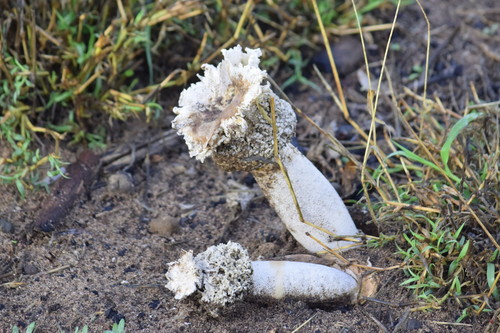
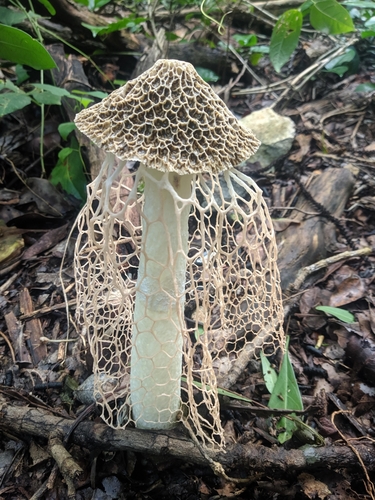
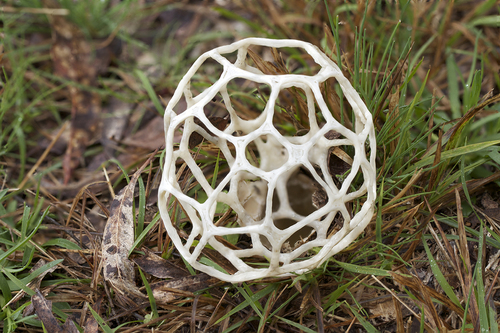
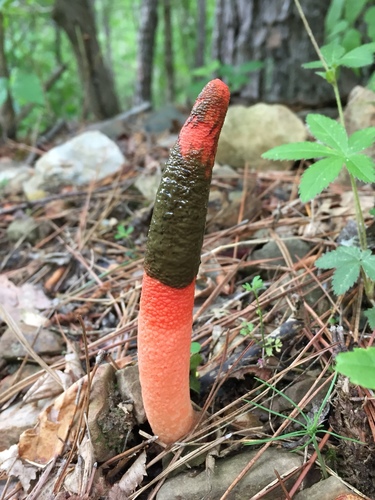
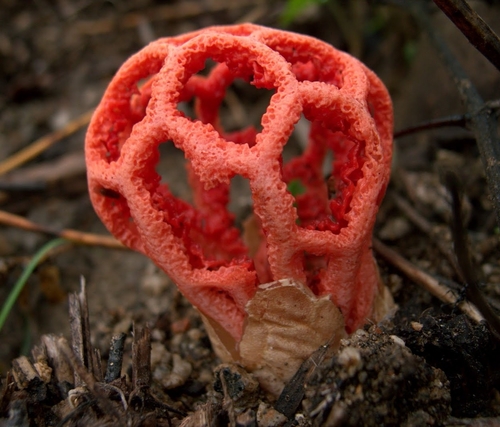
Clathrus ruber P.Micheli ex Pers. develops from an immature closed fruiting body before its outer layer (peridium) opens. This immature stage is egg-shaped to roughly spherical, up to 6 cm (2+1⁄4 in) in diameter, with a gelatinous interior up to 3 mm (1⁄8 in) thick. It is white to grayish, initially smooth, but develops a network of polygonal surface marks as internal structures expand and stretch the peridium before opening. The mature fruiting body, called the receptacle, bursts through the egg as it expands in a process that can take as little as a few hours, leaving peridium remains as a cup-like volva around the base of the receptacle. The receptacle ranges in color from red to pale orange, typically lighter near the base, and its color depends on environmental temperature and humidity. It is made of a spongy network of interlaced arms that form meshes of unequal size. Arms are up to 1.5 cm (1⁄2 in) thick at the top of the receptacle and taper to smaller widths toward the base. A cross-section of an arm shows a spongy structure with one wide inner tube and two indistinct rows of tubes toward the outside. The outer surface of the receptacle is ribbed or wrinkled. The receptacle holds 7–20 angular windows and 80–120 mesh holes, and varies considerably in height from 5 to 20 cm (2 to 8 in). The base of the fruiting body attaches to the growing substrate via rhizomorphs, which are thickened cords of mycelia. A dark olive-green to olive-brown, foul-smelling, sticky spore-bearing mass called gleba covers the inner surface of the receptacle, except near the base. The odor, described as resembling rotting meat, attracts flies, other insects, and one recorded scarab beetle (Scarabaeus sacer) that help disperse the spores. The putrid odor and human reactions to it are well documented. In 1862, Mordecai Cubitt Cooke recorded that a botanist who collected one to dry for his herbarium was forced by the stench to rise during the night and throw the fungus out the window. American mycologist David Arora called this odor "the vilest of any stinkhorn". The receptacle collapses roughly 24 hours after it first emerges from the egg. The spores of Clathrus ruber are elongated, smooth, and measure 4–6 by 1.5–2 μm. Scanning electron microscopy shows that C. ruber, like several other Phallales species, has a hilar scar—a small indentation on the spore surface where it was once connected to the basidium via the sterigma. The spore-bearing cells (basidia) each produce six spores. Like most species in the order Phallales, Clathrus ruber is saprobic, meaning it decomposes wood and plant matter, and it commonly fruits in mulch beds. The fungus grows singly or in clusters near woody debris, in lawns, gardens, and cultivated soil. Clathrus ruber was originally described by Micheli from specimens collected in Italy. It is considered native to southern and central continental Europe, Macaronesia (the Azores and the Canary Islands), western Turkey, North Africa (Algeria), and western Asia (Iran). It is rare in central Europe and is listed in the Red data book of Ukraine. The fungus has likely been introduced to other regions, most often through the use of imported mulch for gardening and landscaping. It may have extended its range north into the British Isles or been introduced there in the nineteenth century. It now has a mainly southern distribution in England, and has been recorded from Cornwall, Devon, Dorset, Somerset, the Isle of Wight, Hampshire, Berkshire, Sussex, Surrey, and Middlesex. In Scotland, it has been recorded from Argyll. It is also found in Wales, the Channel Islands, and Ireland. In the United States, it occurs in urban areas where it was likely introduced, with records from California, Florida, Georgia, Hawaii, Alabama, Virginia, North Carolina, and New York. It also occurs in Canada, Mexico, Australasia, and has been reported from South America (Argentina). In China, it has been collected from Guangdong, Sichuan, Guizhou, and Tibet. Previously published records from Japan actually belong to Clathrus kusanoi, and records from the Caribbean are most likely Clathrus crispus. In North America, this species fruits from October to March. The edibility of C. ruber has not been officially documented, and its strong foul smell discourages most people from eating it. In general, stinkhorn mushrooms are considered edible in their egg stage, and are even considered delicacies in some parts of Europe and Asia, where they are pickled raw and sold in markets as "devil's eggs". An 1854 report gives a warning for those considering eating the mature fruiting body. Dr. F. Peyre Porcher of Charleston, South Carolina described a case of poisoning from the mushroom: after eating a small piece, a young person developed painful tightness in the lower abdomen and violent convulsions six hours later. They lost the ability to speak and fell into a stupor that lasted forty-eight hours. After taking an emetic, they vomited up a fragment of the mushroom, two worms, and blood-tinged mucus. Treatment with milk, oil, and emollient fomentations was successful. C. ruber is generally listed as inedible or poisonous in many British mushroom publications published between 1974 and 2008. British mycologist Donald Dring noted in his 1980 monograph on the family Clathraceae that C. ruber was not held in high regard in southern European folklore. He mentions a case of poisoning after ingestion reported by Barla in 1858, and notes that Ciro Pollini recorded the fungus growing on a human skull in a tomb in a deserted church. According to John Ramsbottom, people in Gascony believe the mushroom causes cancer, and usually bury any specimens they find. In other parts of France, it is thought to cause skin rashes or convulsions.