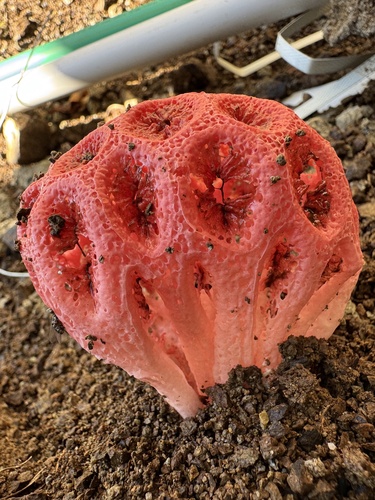
About Clathrus crispus Turpin
The volva of Clathrus crispus Turpin is white, reaching up to 7 centimetres (2.8 inches) in diameter. It is spherical to egg-shaped, marked by a reticulum of grooves that open through irregular splitting at the apex. The fruit body is round to roughly elliptical, measuring up to 10 by 15 cm (3.9 by 5.9 in). Its upper parts are scarlet-red, and it is lighter near the base, which is hidden by the volva. There can be up to about 50 radially grooved holes in the fruit body: these are more or less polyhedral to spherical near the top, and more elongated near the base. The spongy arms are up to about 1 cm (0.4 in) wide, and join at the base to form an overall structure shaped like an inverted cone. The gleba is olive to greenish and slimy, and coats the inner rims of the lattice holes. Spores are elliptical to cylindrical, slightly greenish in color, with dimensions of 3.8–4.2 by 1.8–2.2 μm (up to 0.000165 by 8.7×10−5 in). Clathrus crispus is saprobic, and its fruit bodies grow on the ground singly or in groups. It can be found in gardens, lawns and cultivated soils, especially where wood chips have been used as mulch. A specimen matching the description of C. crispus was recorded from Puerto Rico in 2005. The species has been officially recorded from USA (Florida), Mexico, West Indies (Cuba, Hispaniola, Jamaica, Puerto Rico), and Central and South America as far south as Uruguay and northern Argentina (Cordoba). In 1986, the species was featured on a Grenadan postage stamp.

