About Clathrus columnatus Bosc
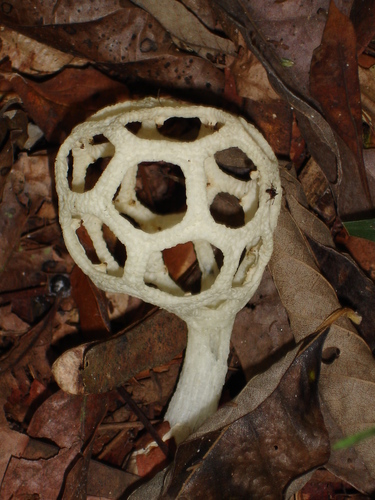
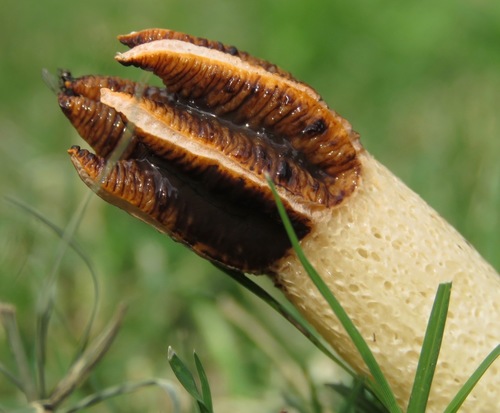
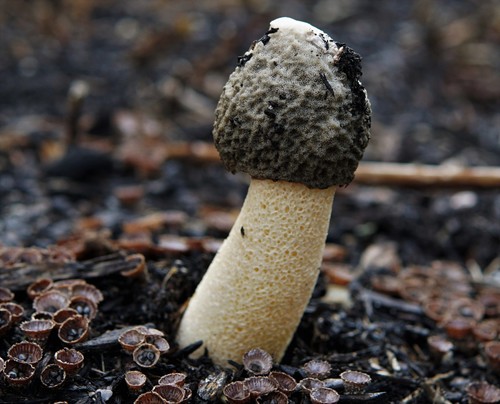
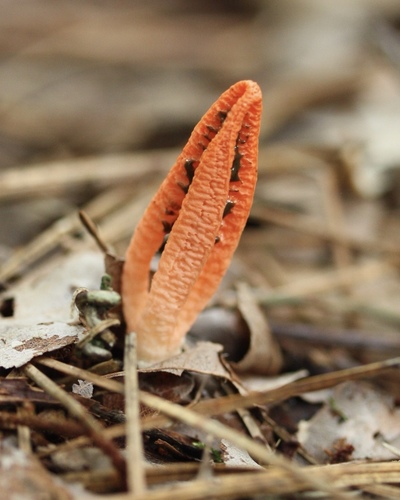
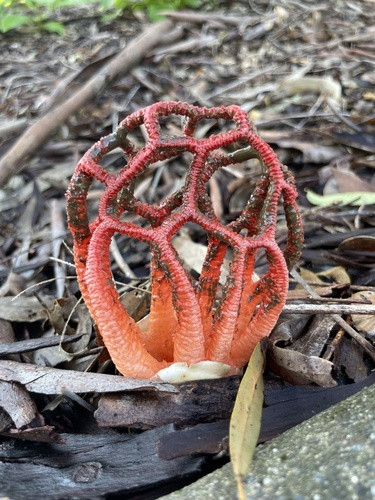
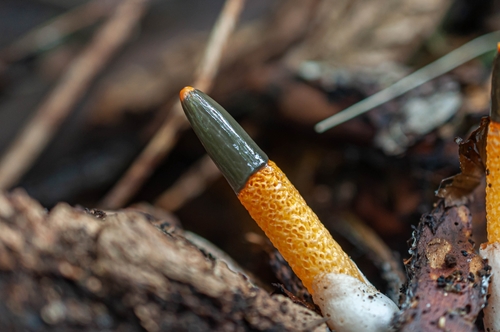
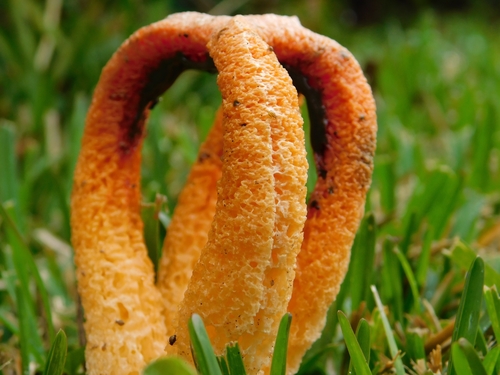
The scientific name of this fungus is Clathrus columnatus Bosc. The mature fruit body (called the receptaculum) is made up of two to five, most often four, spongy vertical columns. The columns are separate where they emerge from the volva at the base, but join together at the top in an arch. Columns are connected in pairs, with opposite pairs connected by a short, broad arch that matches the structure of the columns themselves. Columns are narrower at their base than they are above, and are colored reddish-orange in the upper portion and yellowish-pink in the lower portion. Young, unexpanded fruit bodies are compressed into a small space inside an "egg" structure. This egg has a protective outer layer called the peridium, which is surrounded by a gelatinous layer that encloses the developing compressed fruiting body. The egg is typically gray or grayish-brown, and usually grows to a diameter of 3 to 5 cm (1+1⁄4 to 2 in) before columns begin to grow out of it. After expansion, the volva (the remaining tissue from the egg) stays at the base of the mature fruit body as a thick, loose, whitish sack. The mycelial cords at the base of the volva are constructed from two tissue types: a central bundle of fine hyphae that run along the length of the cord, and an outer cortical layer of coarser hyphae that forms a loose but heavily interwoven structure. Full-grown columns can reach 5 to 8 cm (2 to 3+1⁄4 in) above the ground, which is a height that optimizes spore dispersal. The spore-bearing mass, called gleba, has a fetid odor and is smeared across the upper inner surfaces of the columns. The spores of Clathrus columnatus are elliptical and smooth, with dimensions of 3.5–5 by 2–2.5 μm. They have thin cell walls and are covered by a transparent outer envelope. Like all species in the Phallaceae family, Clathrus columnatus is saprobic: it obtains nutrients from dead and decaying organic matter (such as wood) using extracellular digestion. Due to its preference for dead wood, this fungus is often found in disturbed habitats. It frequently grows in and around gardens and residential areas, where landscaping or cultivation has left accumulations of mulch, wood chips, or other cellulose-rich materials. Its mycelial cords can be traced back to buried roots, stumps, and other woody material. This species grows in sandy soil, near woody debris, in lawns, gardens, and cultivated soil. Fruit bodies appear singly or scattered, and develop in summer, autumn, and early winter, most often after wet weather. Recorded distributions include Oceania (including New Zealand and New Guinea), Africa, China, and North and South America. In China, it has been found in Jiangsu, Fujian, and Guangdong. In North America, its range extends north to New York, south to Mexico, and also includes Costa Rica and Hawaii. It is less common in the southeastern and southern United States. It is thought to be an introduced species to North America, since it typically grows in landscaped areas or sites where exotic plants have been established. Australian mycologist Tom May notes that a reported Australian distribution is "presumably erroneous", as it is based only on a single 1948 collection. Like other members of the Phallaceae family, mature Clathrus columnatus uses its strong odor to attract insects that help disperse its spores. One species of stinkhorn sap beetle, Psilopyga fasciata, has been recorded feeding on the gleba of Mexican specimens. William Gilson Farlow published a 1890 warning about potential consumption of this fungus, noting that the repulsive odor of mature phalloid fungi has often led to experiments testing whether they are poisonous to humans. Farlow documented two cases of poisoning: one involved a young girl who ate a small piece of the fungus, experienced violent convulsions followed by loss of speech and a 52-hour deep sleep; the other involved hogs that ate the fungus growing in oak woods, which died 12–15 hours after consumption. Despite this early report of poisoning, Orson K. Miller, Jr. notes that the unexpanded egg has a mild taste, and lists Clathrus columnatus as edible.