About Clarkia unguiculata Lindl.
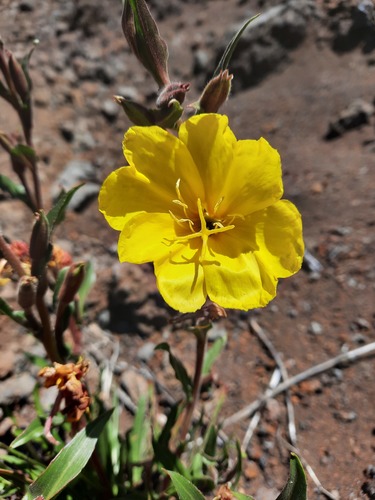
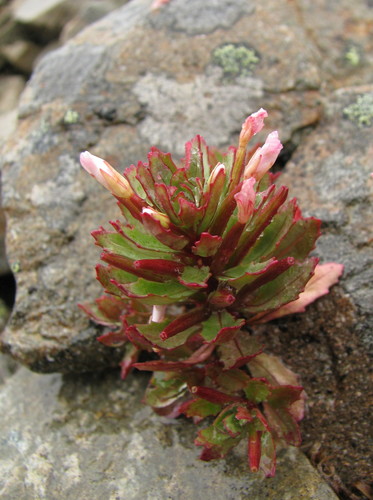
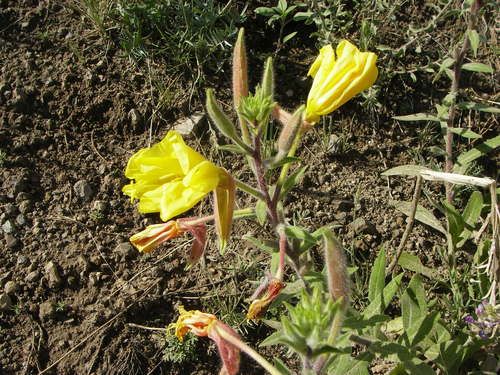
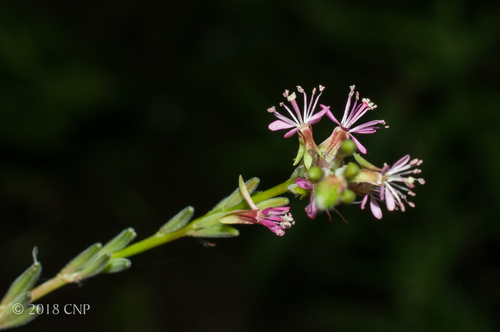
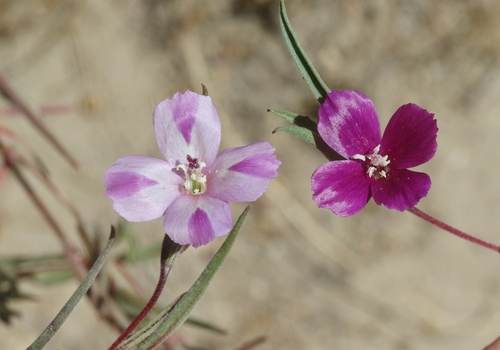
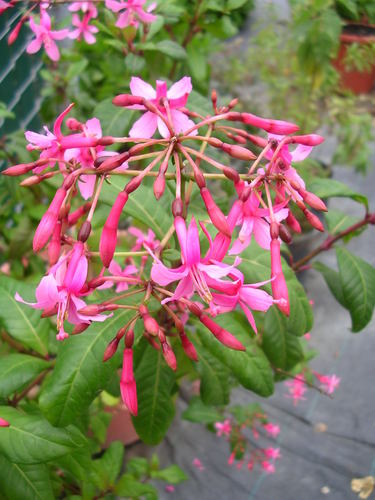
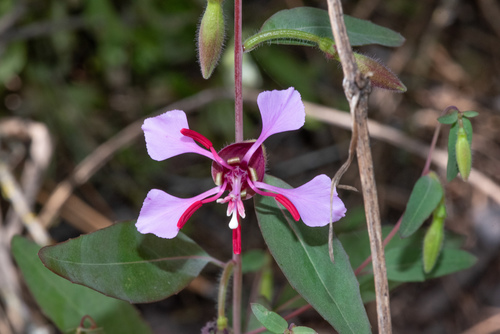
Clarkia unguiculata Lindl. has a spindly, hairless, waxy stem with a red tint, and grows up to 3 ft (0.9 m) tall, with only a small number of leaves along the stem. Leaves are arranged oppositely at the base of the stem, and become alternately arranged further up the stem. Its showy flowers grow in a raceme, where each flower attaches to the main stalk via a short stem extension called a pedicel. The flowers have hairy, fused sepals that form a cup beneath the corolla, and four petals each 1 to 2.5 cm (1.0 in) long. The petals are paddle-like, slender, and either diamond-shaped or triangular, and range in color from pink to reddish to purple. There are eight long stamens total; the outer four have large red anthers. The stigma protrudes from the flower and may be quite large. The pistil is a long white structure, and the combination of the white pistil and red stamens makes this flower easy to identify. This species produces a small indehiscent nut-like fruit that holds many tiny seeds. This plant is endemic to California, where it grows in many woodland habitats. It occurs along the coastal ranges from Mendocino to San Diego, and also grows in the Sierran foothills. It is specifically common on the forest floor of many oak woodlands, growing alongside typical understory wildflowers including Calochortus luteus, Cynoglossum grande, and Delphinium variegatum. It flowers in summer and fall, and thrives in somewhat neutral soil pH. It is most often found on open slopes or in slightly shaded areas, at elevations below 5,000 feet (1,500 m) in dry conditions where it grows well. Clarkia unguiculata is pollinated by a variety of bees, butterflies, and some bats. Its main pollinator is Hesperapis regularis, a native bee species that lives in environments similar to those occupied by C. unguiculata. This species is capable of self-pollination, so it is less dependent on pollinators such as bees or butterflies to reproduce. The caterpillars of the mariposa forester moth feed on this plant. This species is cultivated in gardens, and requires dry air and dry soil to bloom. It can be grown in sand, loam, or clay soils, as long as the growing conditions remain dry. As a hermaphroditic species, it is easily pollinated by pollinators and requires less energy from the plant for pollination. It cannot be grown in shaded areas, and requires exposure to sun for most of the day. It also does not tolerate cold conditions well. When grown correctly, its seeds germinate within two weeks, and it blooms in late summer and early fall. Although the plant is not typically eaten, some of its parts are edible, specifically its seeds. The seeds can be eaten raw or cooked, and can also be ground into a fine powder.